

Employment data was weaker than expected
Inflation data remains sticky, but not necessarily increasing steeply
So what?
Bond markets are still moving swiftly with inflation concerns, and this may be enough for the Fed

M2 Money Supply
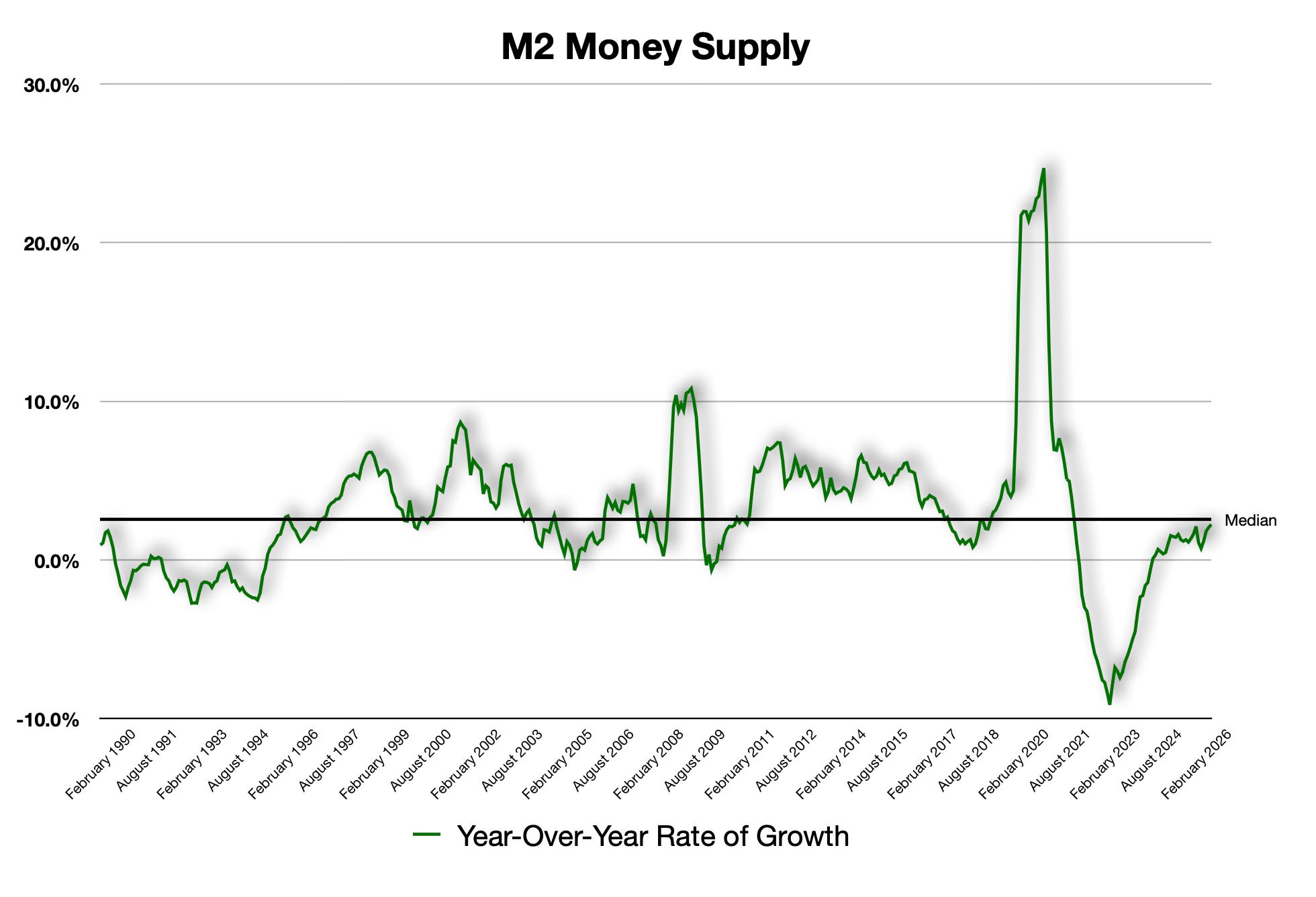
Inflation is a monetary issue, until it is not. Over the past two weeks, data showed up pushing the money growth rate upward. This, in itself is inflationary and if money supply growth were the only variable at play, I would say that price pressures would increase on their own. There is more to the current economic landscape than merely M2 money supply growth.
To start, price pressures are elevated and sticky. What is important about that is that none of the current price pressures growth is owed to money supply growth. Instead, tariffs and now fuel prices are what are driving price pressures. Adding in to this is both the low employment situation as well as ultra-low confidence numbers for consumers. In theory, with consumer incomes and expenditures, coupled with consumer confidence at very low rates, economic activity would likely come to a standstill; it is not—the consumer is hanging in there, and that is not a position the consumer should be forced into.
I don’t believe that the Fed is going to push too much further beyond these current levels, although there may be .25 - .50 more basis point increases in the future. The reason is that the long end of the yield curve may help out the Fed to curb monetary growth gains, and by extension price pressures.
Personal Income & Personal Expenditures


Both personal incomes and personal expenditures remain at levels that are sub-median. Yet, both are neither falling nor well below the median. On the one hand, confidence is still very near all-time lows, yet expenditures are still hanging in there. That is the issue, however, in that the consumer is in a position where they are “hanging in there” versus propelling the economy.
Consumer expenditures drive a solid portion of the US economy. What the consumer is not doing is pushing the consumer portion of the economy into any meaningful expansion growth pace. Instead, it is AI stocks that are continually moving the stock market.
One of the very biggest issues I have with the moves in AI is that growth rates are highly disproportionate to what the economy is capable of. Most in the AI sphere are stating that AI will push the economy to new growth levels: I don’t buy that one bit.
Eventually, the stock market will resemble more of a classical economic framework once reality hits the AI-bubble.
PCE Deflator (Inflation)
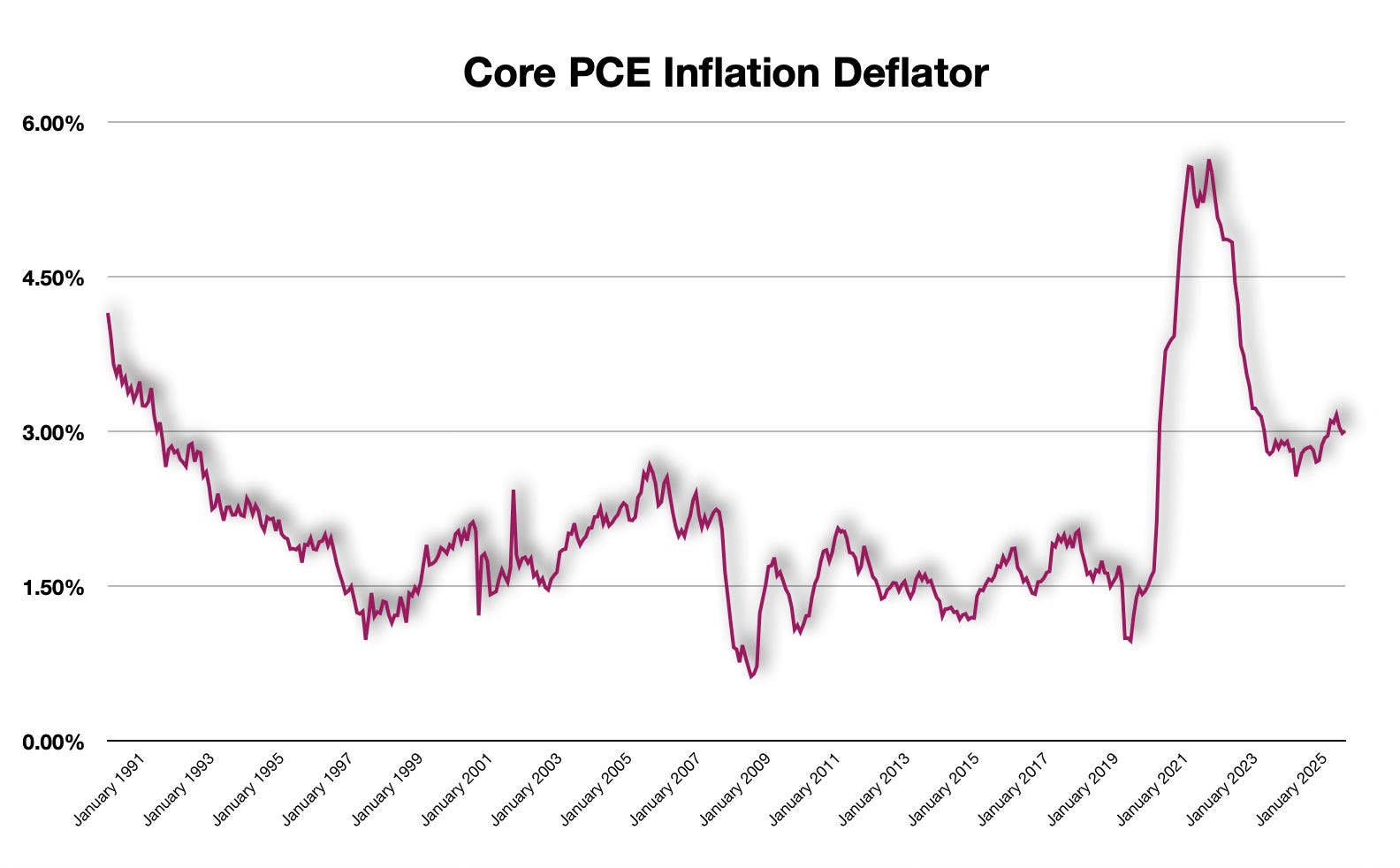
Inflation is sticky, and this will put the Fed in an interesting position. The Fed will want to prove its inflation-fighting capabilities, and this month’s latest release of the Core PCE will probably keep the Fed thinking.
It is the long end of the yield curve that I believe will have the biggest effects on the economy as higher yields restrict economic activity more so than the Fed raising its short-term borrowing costs. In fact, I am not too certain the Fed will need to do too much at this point further considering where interest rates are relative to inflation. I can see an additional 25 basis point hike, then a wait-and-see mode hitting the Fed. These higher yields will have an effect on the economy, and then once oil officially begins flowing through the Strait of Hormuz, the effects of higher fuel prices will narrow inflation concerns.
And then there is the employment situation.
Employment


Employment was limp this month, and I expect in an environment where oil prices remain elevated, consumer expenditures would be limited in raising the growth rate of the economy.
I can see the next couple of months printing negative employment numbers, but not recessionary-sequence numbers.

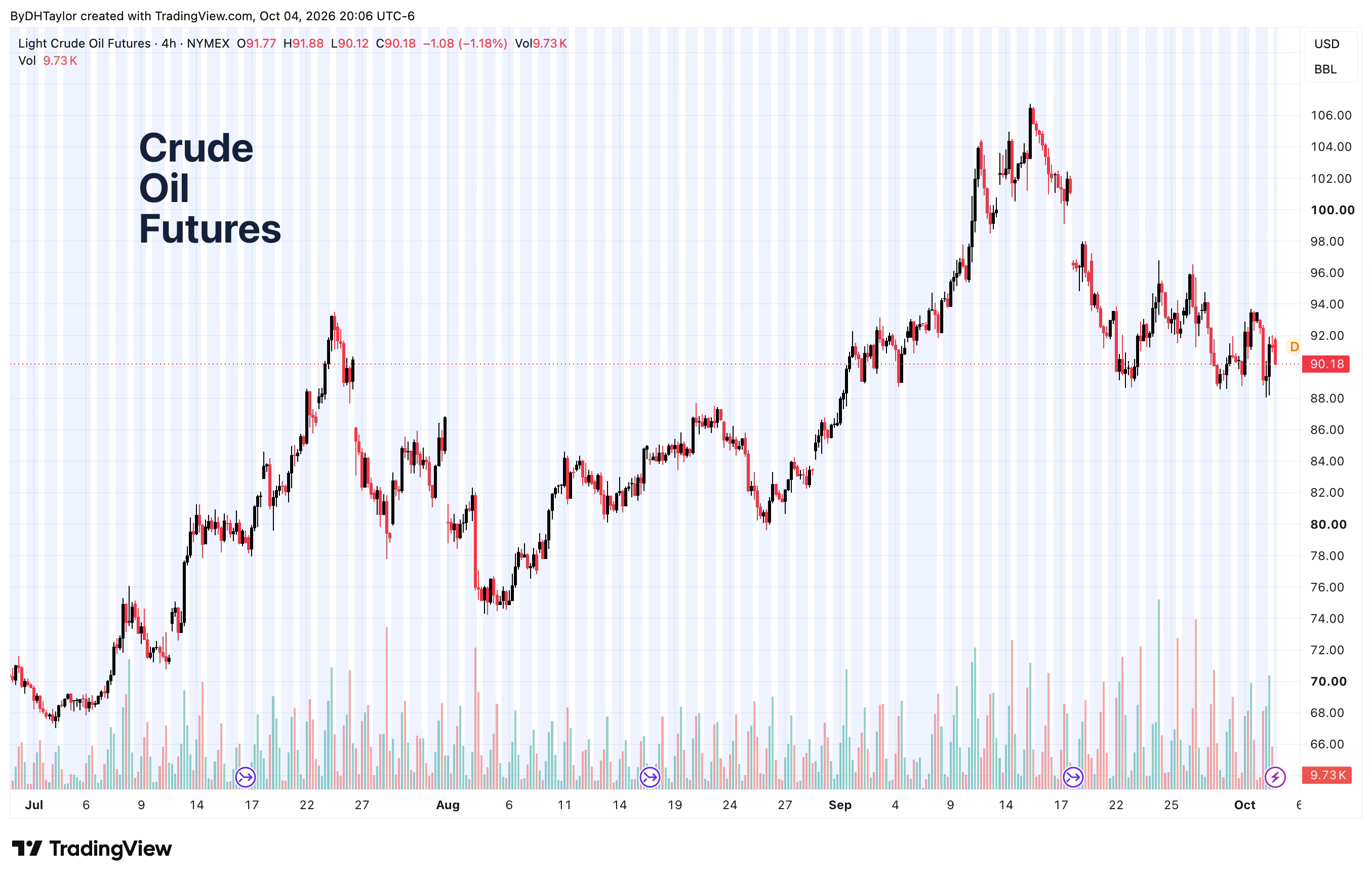
It seems more probable than not that a full resolution will occur in the Middle East. Saudi Arabia is reportedly pushing out about 18M barrels a day via alternative routes, yet there are still shortages. These shortages are likely to remain for many, many, many months. Until supply comes back to pre-war levels, prices will remain at these higher levels. While I do not see any reasons for the price of a barrel of oil to shoot back upwards because of more conflict, that may still be priced into the market.
At some point, the market will get ahead of the economics of oil, and prices will drop. For now, large amounts of risk are still priced into the market.

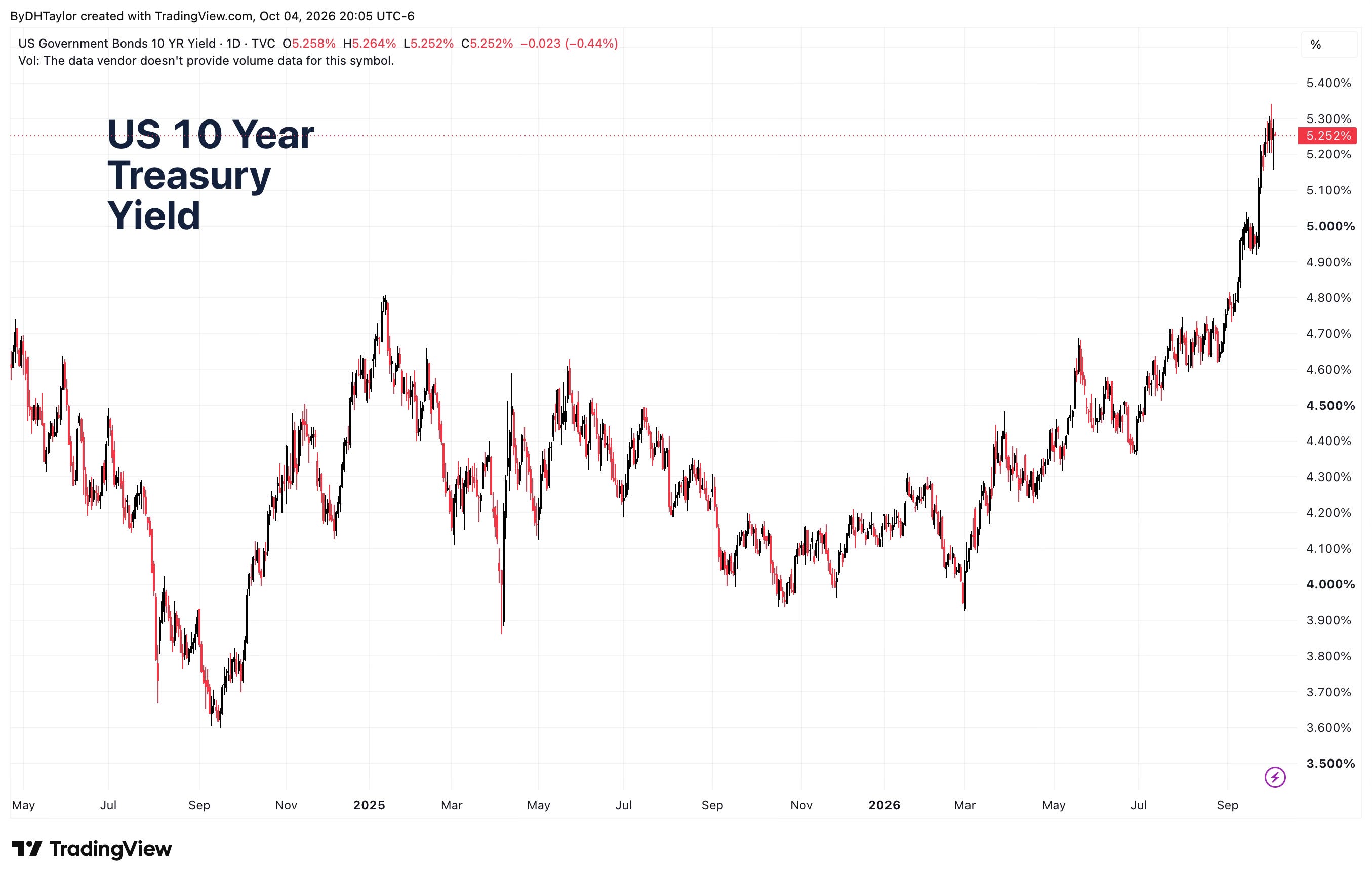
Bond yields are soaring—it’s never just one thing:
Bank of Japan continues to ween bond purchases
Inflation continues to remain sticky
The US deficit will hit $2 trillion
AI hyper-scalers are bobbing up all debt investment capital
Bond yields are flying.—This is not all due to inflation. One of the key reasons for the sharp increase is that bond yields around the world are actually moving higher rapidly, and because of that, worldwide debt is normalizing. Simultaneously, AI hyper-borrowers are consuming a lot of potential money going to other investments such as government bonds.
The Bank of Japan has slowed its purchases of Japanese Government Bonds, which that had artificially held prices high in order to keep yields low. Japanese investors were chasing yields around the world in lieu of ultra-low, and artificially priced Japanese debt instruments. This process kept US debt instruments at lower-than-normal levels.
Now that the Bank of Japan is slowing that regime, the world is feeling the effects of bond yields at more normalized levels instead of artificially supported rates. Japanese investors are slowly adding their own bonds to their portfolios, and this is dwindling the number of buyers for US debt instruments—price must drop to entice investors.
After that is considered, there is the amount of debt the US is taking on, which adds to even more pressure on price to entice buyers; it is of no help that the current administration is not going around trying to seek debt to foreign investors, but instead going out of its way to insult foreign investors.
I expect the long-term outlook for bond yields to continue higher, but not in a linear straight line. If the Treasury market were to collapse completely, the world economies would take note and steps to stem this, giving the world’s biggest market a bump.
In the meantime, these higher yields will help to reign in economic activity, but that is at the expense of economic activity. If rates remain high for a very long time—I do not expect them to go back down below the 4.00% at any point—this will contain some economic activity, which that will help with price pressures.

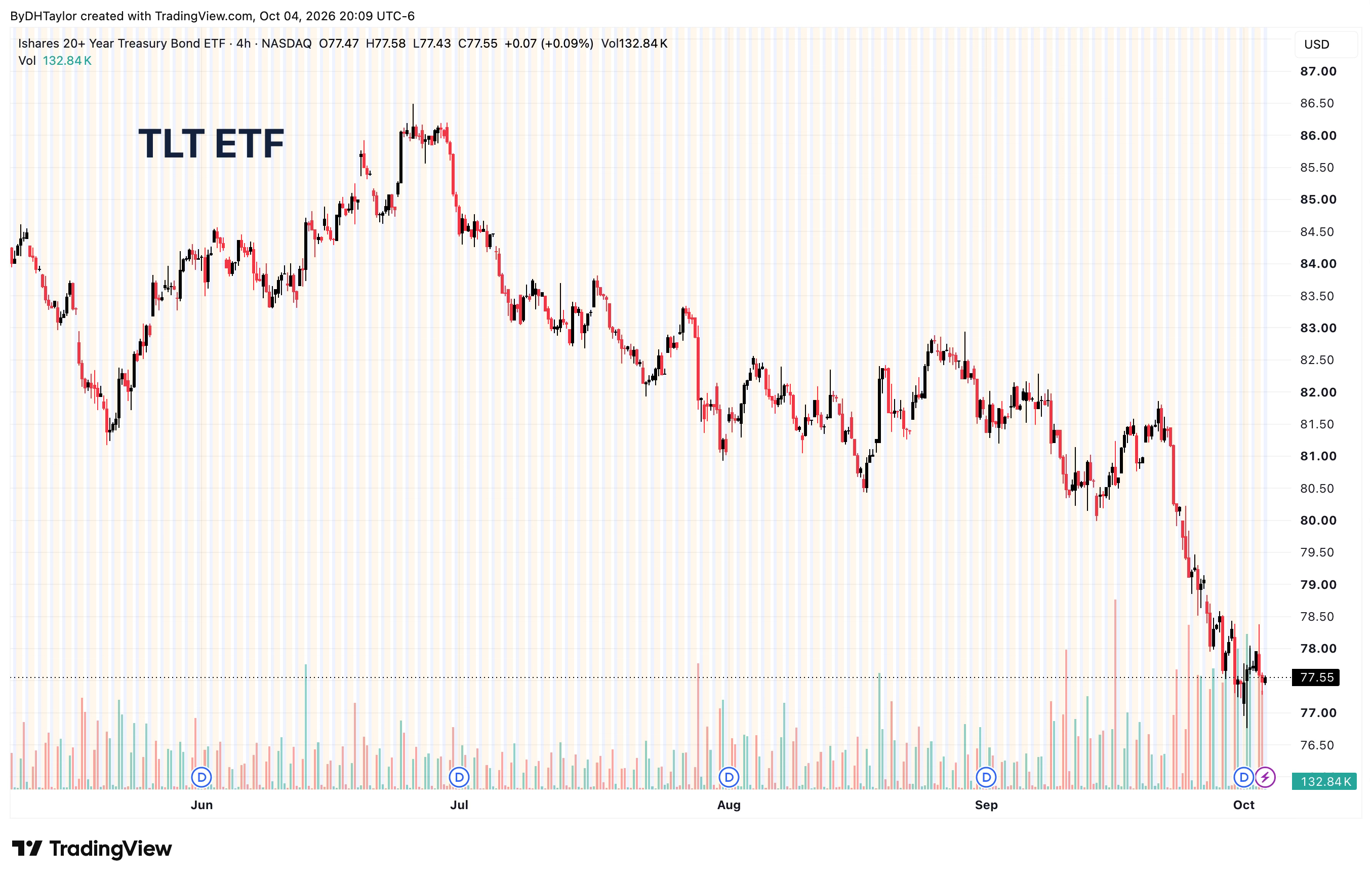
I took profits on my short TLT ETF trade with over $3.00 in profits, which was a nice take. For many, many months, I had been eating peanuts selling call options knowing that the most likely move would be lower, which that is exactly what has occurred.
I am still short on a fairly large SPY ETF position, and I will take profits over a few months. The stock market is still trending upwards, but eventually, I expect that cage to get rattled. With enough buying and selling, the positions I do have on SPY ETF are paid for, so turning them into bigger profits would be a benefit.
From a purely classical standpoint, the economy is strained, and many stocks should be pressured lower. Unfortunately, the AI trade is nowhere near a classical position. I do not expect a complete rout of AI stocks, but instead a long disappointing move lower, one stock at a time. That appears to be about the only thing holding the stock market up at this point; let’s see how long that lasts.
