
We are living with diverging economies, and we are about to get more information over week. The stock market is regularly hitting new all-time highs. However, this is driven entirely by AI investment and returns. What about the ‘real’ economy?
This begs to question what the real economy even is? The US economy is primarily a consumer-driven economy—a little over 70%. If consumers are increasing or decreasing their expenditures at a growing or declining rate, the economy will expand or contract at a correlated rate. Because the consumer represents such a big portion of the overall economy, their collective ‘health’ is important.
Understanding this is the main focus of my analysis and something I am always tuned into. The consumer has been weighed down heavily from tariffs, and this is affecting consumer stocks.
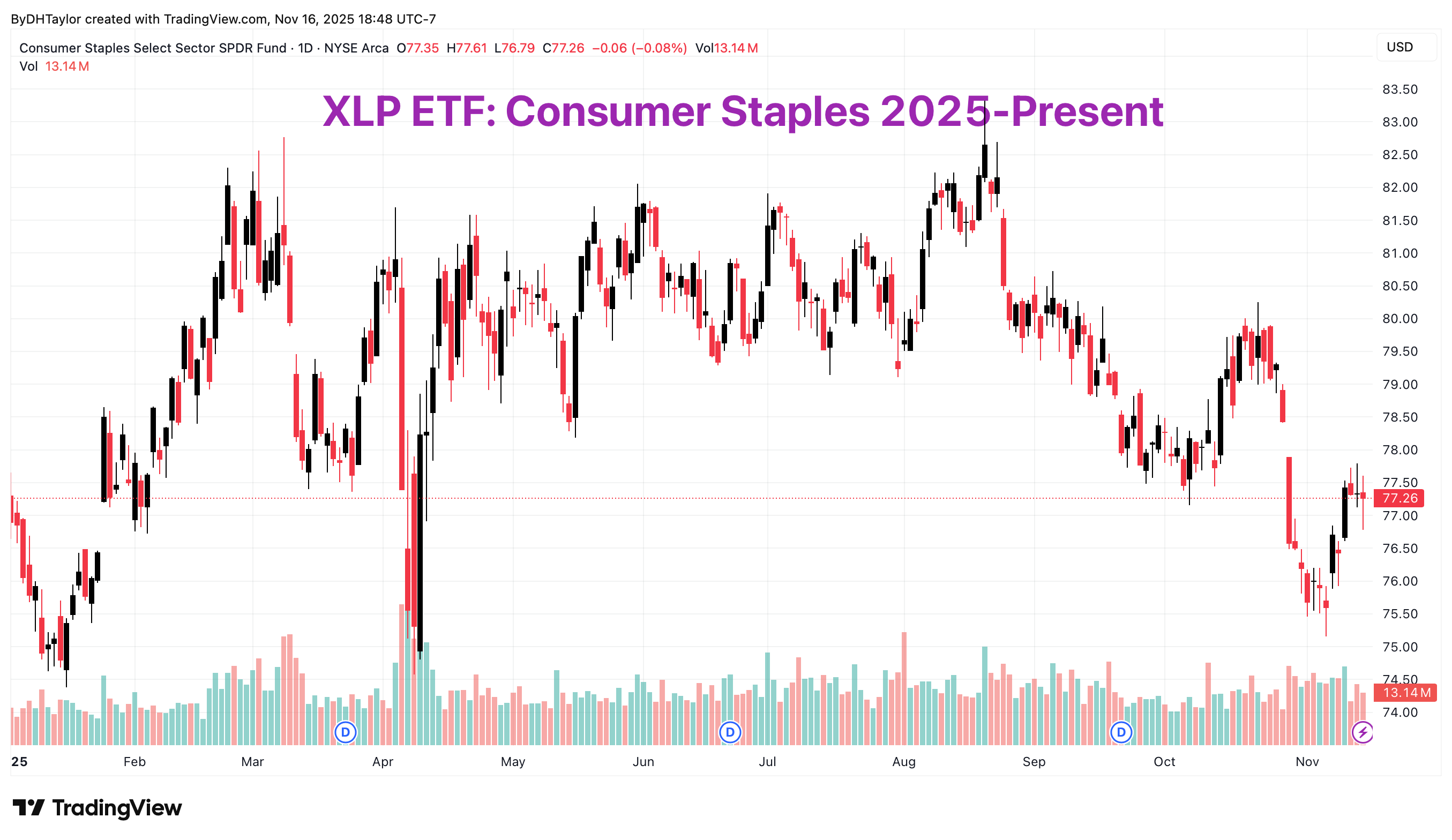
If you look at the chart above, it is XLP ETF, the consumer staples sector of the stock market. Since the beginning of the year, there has been very little gains or losses in XLP ETF, whereas in stark contrast, SPY ETF, the overall broader stock market ETF with all 11 sectors.
Consumer expenditures have been significantly impacted by the imposed tariffs. Tariffs are a tax, which the government has been happily collecting. But consumer incomes are finite. Because of the tariffs, there will be tradeoffs. Consumers will have to give up something in order to buy another as the government collects a bigger cut of the purchase price of any item—have you been to a grocery store lately?
The end result is that consumer spending is still occurring, just at a lower level than it could be because of the tariff tax.
This week, we get earnings releases from Nvidia, which is the big headline for the stock market. I think the numbers will be in line with expectations so I am not too focused on NVDA right now.
Beyond this, I am looking to the broader market to see what will happen with the economy and the current effects the tariffs have had on economic activity.
Along with NVDA stock earnings, we also get Home Depot (HD), Lowes (LOWE) Walmart (WMT) and Target (TGT), all of which have underperformed the overall stock market. That’s not surprising at all.
What I want to know first is how poorly these companies have performed as a result of the tariffs.
However, I am also willing to look past each companies current disposition because although consumer sentiment is in the gutter, the government shutdown has been resolved (for now), and more likely than not, the tariffs will be removed via the Supreme Court.
SPY ETF: 2025-Present
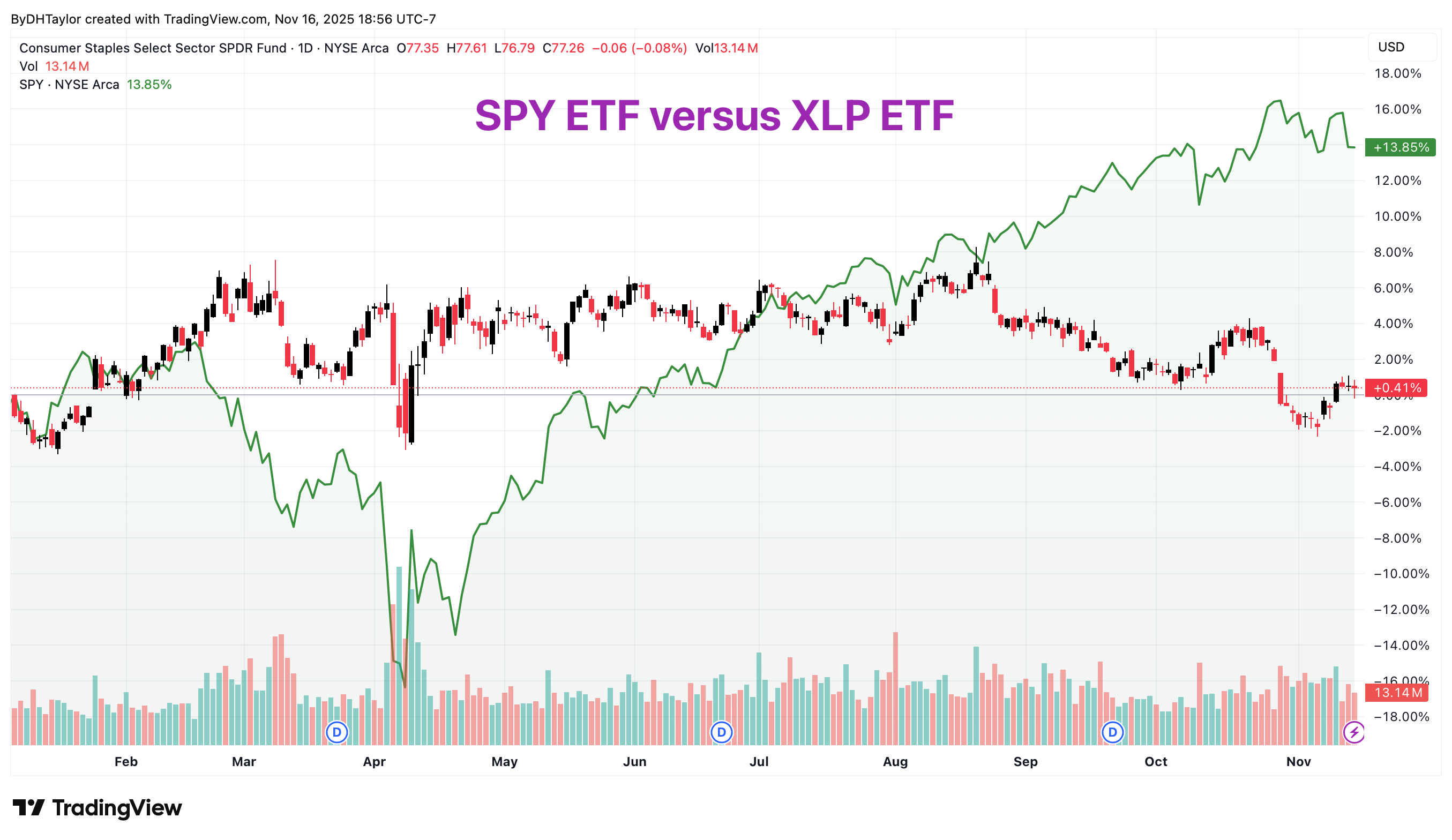
Looking at any one chart does not do much good unless you compare it to another. Above, SPY ETF and XLP ETF are shown since the beginning of the year. SPY is up about 13.5% year-to-date. XLP ETF has barely budged.
That being said, SPY took a solid hit in April, whereas XLP barely budged.
However, for even broader comparison, take a look at Nvidia stock (NVDA) versus SPY ETF which shows how closely correlated SPY is to NVDA, and that NVDA is up some 22% for the year. This has been the main driver of the overall stock market.
And yet, the consumer is some 70% of the economy!
Consumer Confidence versus Personal Expenditures
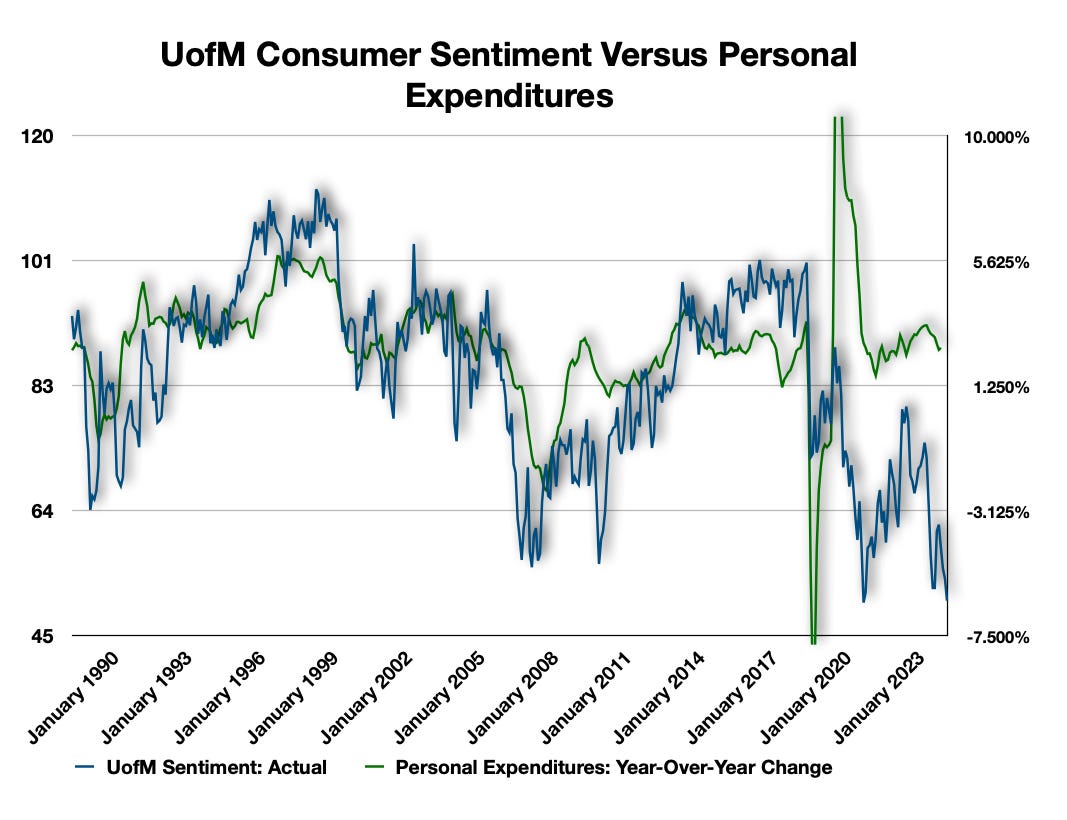
Confidence and expenditures go hand-in-hand. The chart above shows the latest University of Michigan Consumer Sentiment Index versus Personal Expenditures. The latest UofM number is at its 2nd-worst reading of all time.
That reading has been driven by the government shutdown and tariffs. The shutdown has ended—for now (the current appropriations bill only goes until January 31st of 2026)
As for the tariffs, I have maintained that they are unconstitutional and be struck down since the day they were imposed. So far, two courts have ruled that way. The Supreme Court recently took arguments and as far as any witness can conclude, the court appeared very dubious of the government’s assertions. I believe that the tariffs will be struck down, and because of that, there will be an overall reversal in the consumer’s disposition.
This would also drive consumer stocks.
Money Supply versus Stock Market
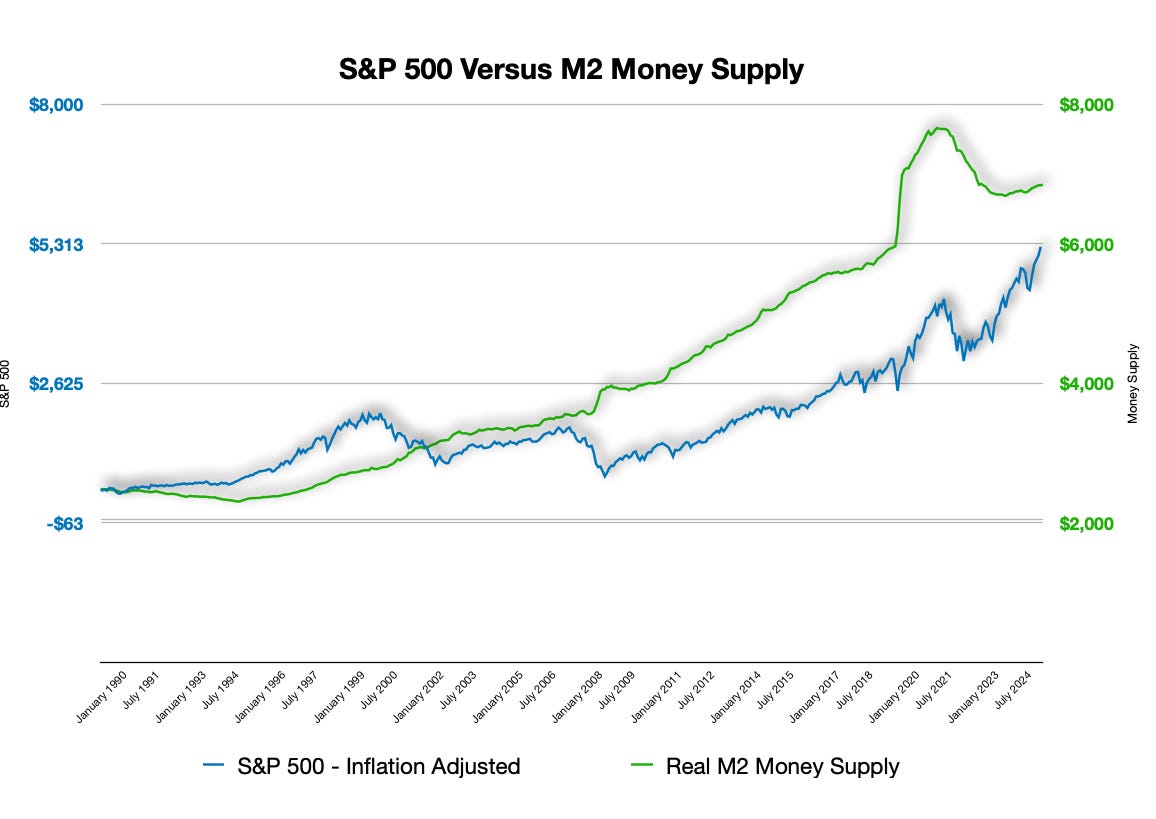
Consumer confidence and consumer incomes are some of the most important data points that I follow to determine what will happen next with the stock market. The other thing is the money supply.
All of this goes hand-in-hand.
Our economy lives in a fractional banking world. If more and more money is being created, this trickles through the economy. As more and more firms take on investment opportunities by borrowing money, expanding the money supply, that money leads to individuals getting hired. New hires gain income, which then creates expenditures within the economy.
All of that money, and the rate of it increasing, drives new revenue for firms, which then expands through to the stock market driving stock prices.
I expect that the more broad stock market will see increased opportunities as the tariffs are shot down.
My Take: Watch for Tariff Relief
The shutdown has weighed on consumer confidence along with the tariffs. The shutdown is now over, and that will help in confidence.
Tariffs are a tax, and they have impacted consumers significantly. But the tariffs are likely to be shot down soon. This, more than anything will relieve the consumer’s disposition.
Given that, I can see a lot of upside possibilities with XLP ETF. Some firms could see increased revenues because the consumer won’t be taxed on individual consumption. Since incomes are finite, and the government won’t be collecting a sales tax on purchases, more income will be allocated back to normalized expenditures.
In fact, this could push some stocks far higher.
We will get more news on the consumer and how each company sees what will happen next this week with individual earnings releases. As I mentioned, I am looking beyond these numbers because to me it is only a matter of when the tariffs are removed, not if.
There is a caveat, of course: What if Nvidia has a bad day this week?
