

Inflation has been above target for over 60 months
Current interest rate levels are non-restrictive given employment and growth
So what?
Several Fed members are now signaling that higher rates are going to happen—here’s how I am positioning my portfolio

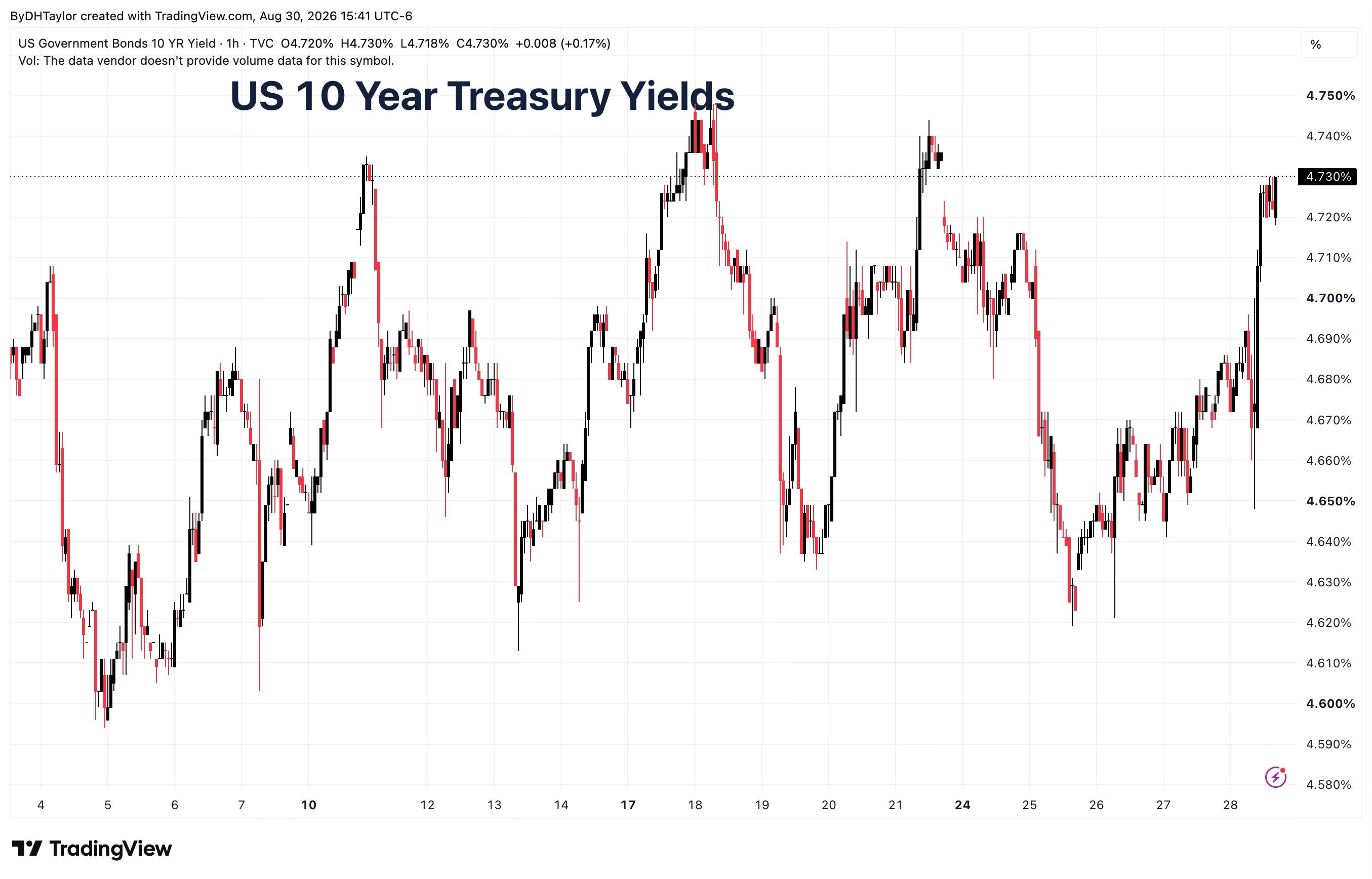
At the Jackson Hole symposium, Kevin Warsh, the newly appointed Federal Reserve Chairman made remarks that is giving the markets an idea of forward guidance; although specifically said he was not giving forward guidance. Inflation has been too high for too long, and the level of interest rates is not having any restrictive effect on growth overall. Given this, and many comments by a few other Fed board members, the markets interest rates moved higher during the session.
I have been clamoring for some time that interest rates would need to move significantly higher, and we are likely seeing the beginning of this process play out.
The question is: How far will interest rates move higher?
I believe interest rates will very slowly and gradually move higher, but I do not see a recession because of this. Also, I believe that baring any major economic downward shifts, the economy will continue to expand despite higher interest rates, while also there will be lower price level increases.
Along with the interest rate driving comments, last week economic data was released that helps support why interest rates will move higher.

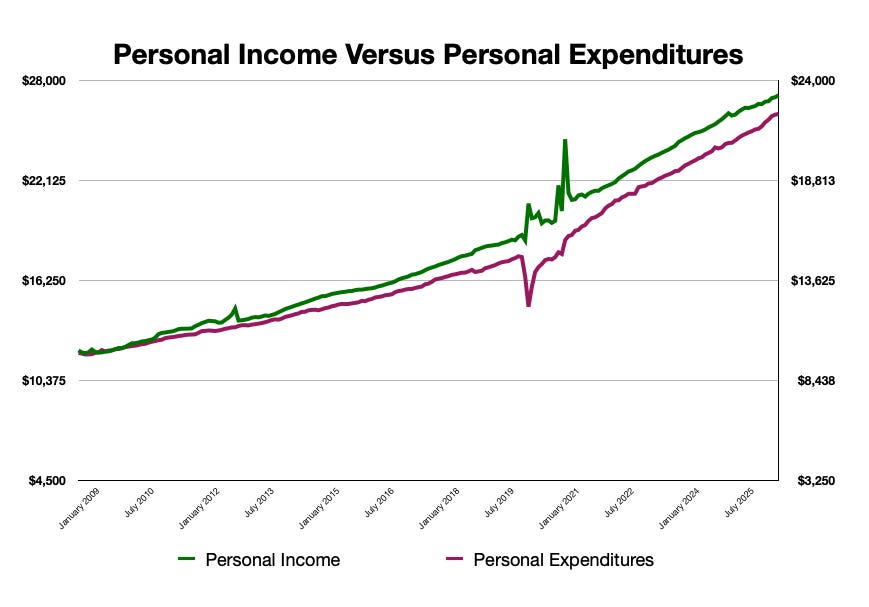
This chart above is the baseline numbers for both Personal Incomes & Personal Expenditures. This chart shows the baseline numbers that the Bureau of Economic Analysis produces monthly.
This data says quite a lot regarding pace. Specifically, if you look at the angle of the chart from COVID onward, you can see their increase has risen faster than previously. The pace of acceleration is far greater than normal. Since COVID, both incomes and expenditures have gone steadily higher and higher, but at a mathematical angle that is greater than what we normally see. That pace is why everything feels out of reach because it is higher than it normally is.
After the Dot.com crash and after the financial crisis, there was a more gradual incline in the rate of increase in both incomes and expenditures.
This has not been the case since COVID; all one would need to do is look at the chart to see the angle that both have been moving, especially expenditures.
The reason for this? Inflation.
Personal Consumption Expenditures (PCE) Deflator
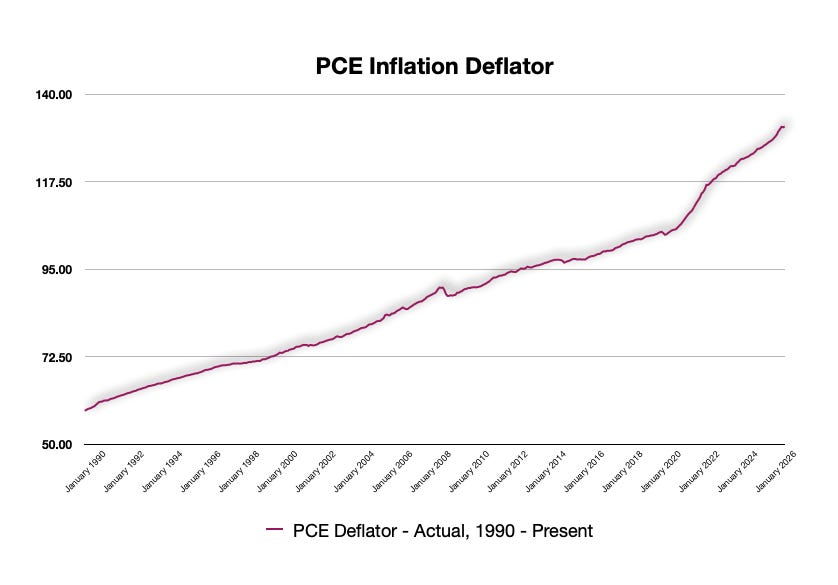
This chart above is the inflation deflator within Personal Incomes & Expenditures from the Bureau of Economic Analysis. I use this chart to discount prices back to levels in order to keep these price levels comparable. The sharp rise indicates that price increases are continually moving higher at a rate that has been exceeding normal levels.
The reason for this continual uptick in the pace of growth of expenditures are price increases. The consumer is not necessarily spending more to enjoy more, but instead spending just to keep pace.
The Federal Reserve “targets” price increases at about a 2.00% annual rate of growth. Currently, the PCE Core rate is sitting above the 3.02% level. In fact, the Core PCE Deflator has been above the 2.00% level for over 60 months.
Money Supply
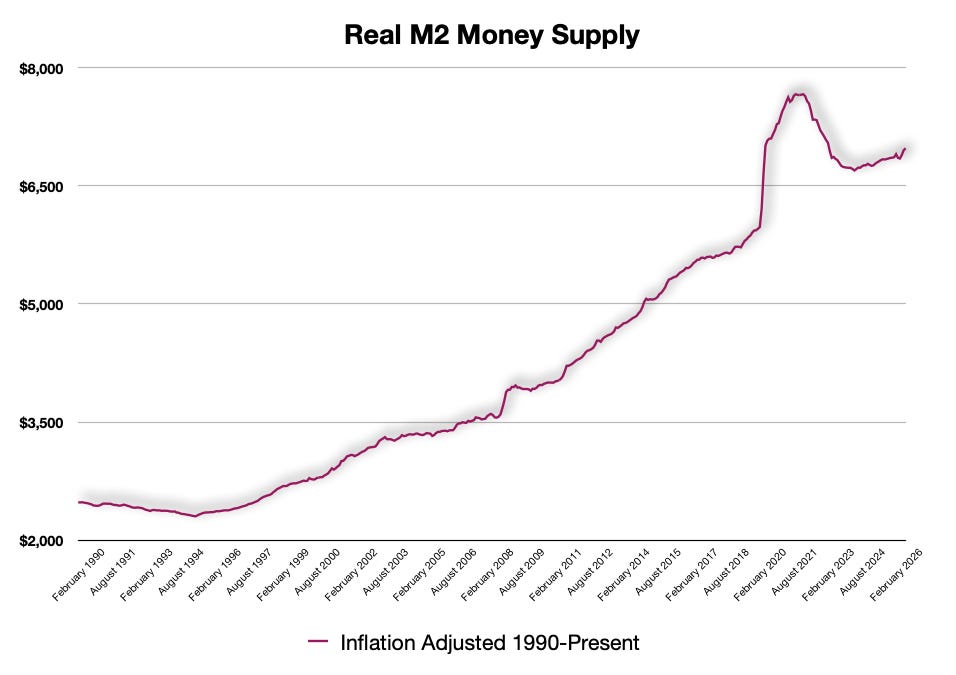
This chart is the total M2 money supply, which there is a massive obvious blob towards the end of the data. When COVID hit, the Federal Reserve made moves coinciding with the Federal Government’s programs to support the economy during the shutdowns.
That bulge represents a massive increase in money. While the trend line growth rate has returned to what might be the normal ascent rate, there has not been any significant drawdown on the money supply.
The real thing to keep in mind is that inflation is a purely monetary phenomenon. If the money supply growth rate is modest, and below-trend, inflation will follow suit. Counter to this is that if there is a massive increase in the money supply, there will be an in-kind increase in the rate of growth in prices.
During the COVID shutdowns, and the subsequent liquidity increase during that period of time, instead of interest rates reacting to price increases by moving higher, interest rates were kept artificially low to allow for increased economic activity.
The end result was price increases that resulted in the Federal Reserve finally pushing interest rates significantly higher to stem upward price pressures.
What the Fed did not do, however, is to allow price pressures to fall back down to target levels; they never hit the Fed’s target goals.
Since that time period, other shocks to the system have occurred, and now price pressures are moving higher again.
There are other factors that are driving interest rates higher, and the biggest is the government deficit, which the debt is increasing at an alarming rate. Given the amount of debt the government has to finance, investors are asking for higher interest rates in return for holding onto the investment for long periods of time—term premium.
Government Debt
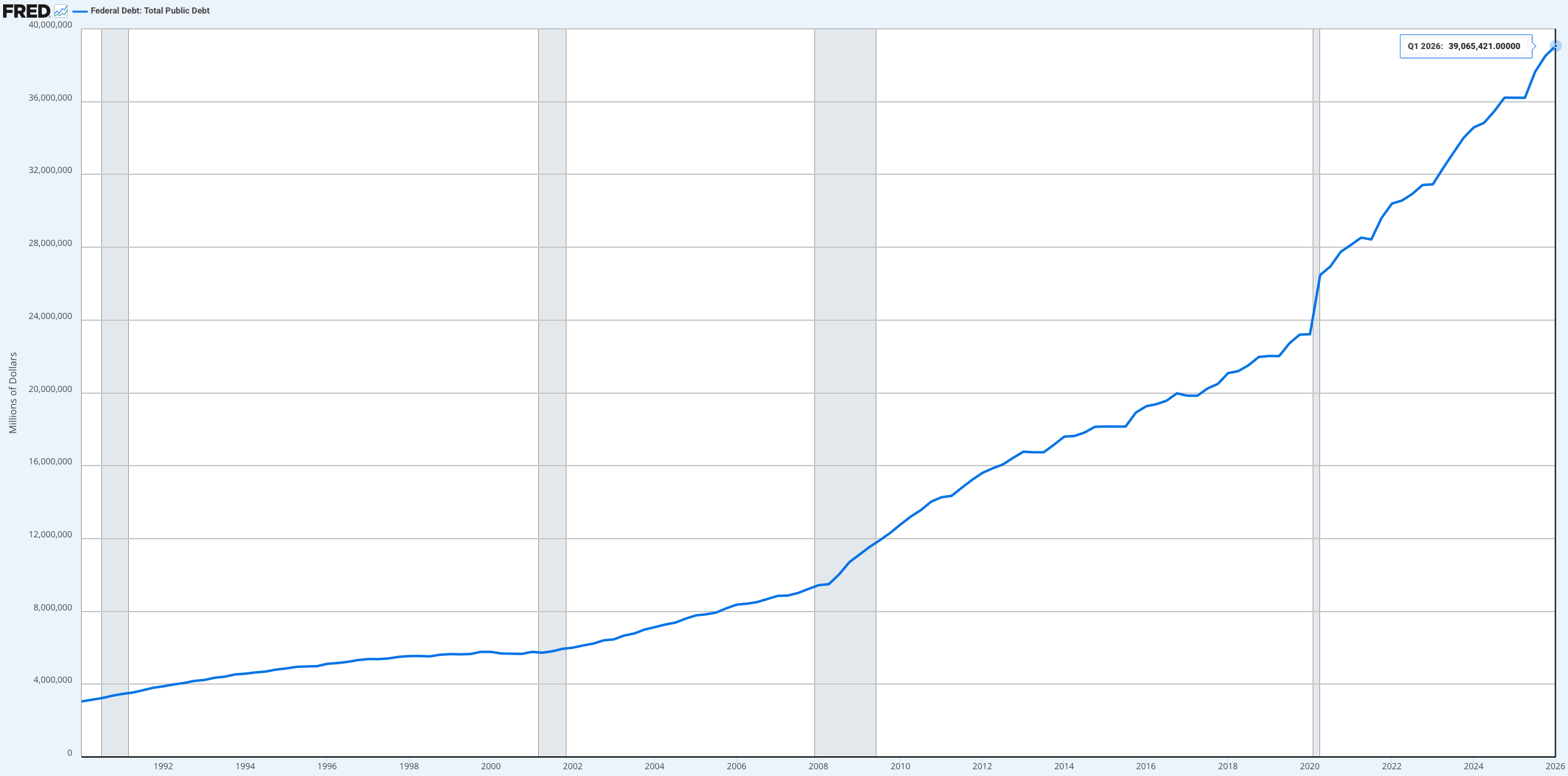
It is interesting that we are being told that this is the greatest economy we have ever seen: For whom, would I ask? While we are in the midst of the greatest economy, would the government not bring in the highest level of taxes during that period? The deficit is expanding at a fast pace, and this is putting pressure on the bond markets.


Treasury Yields
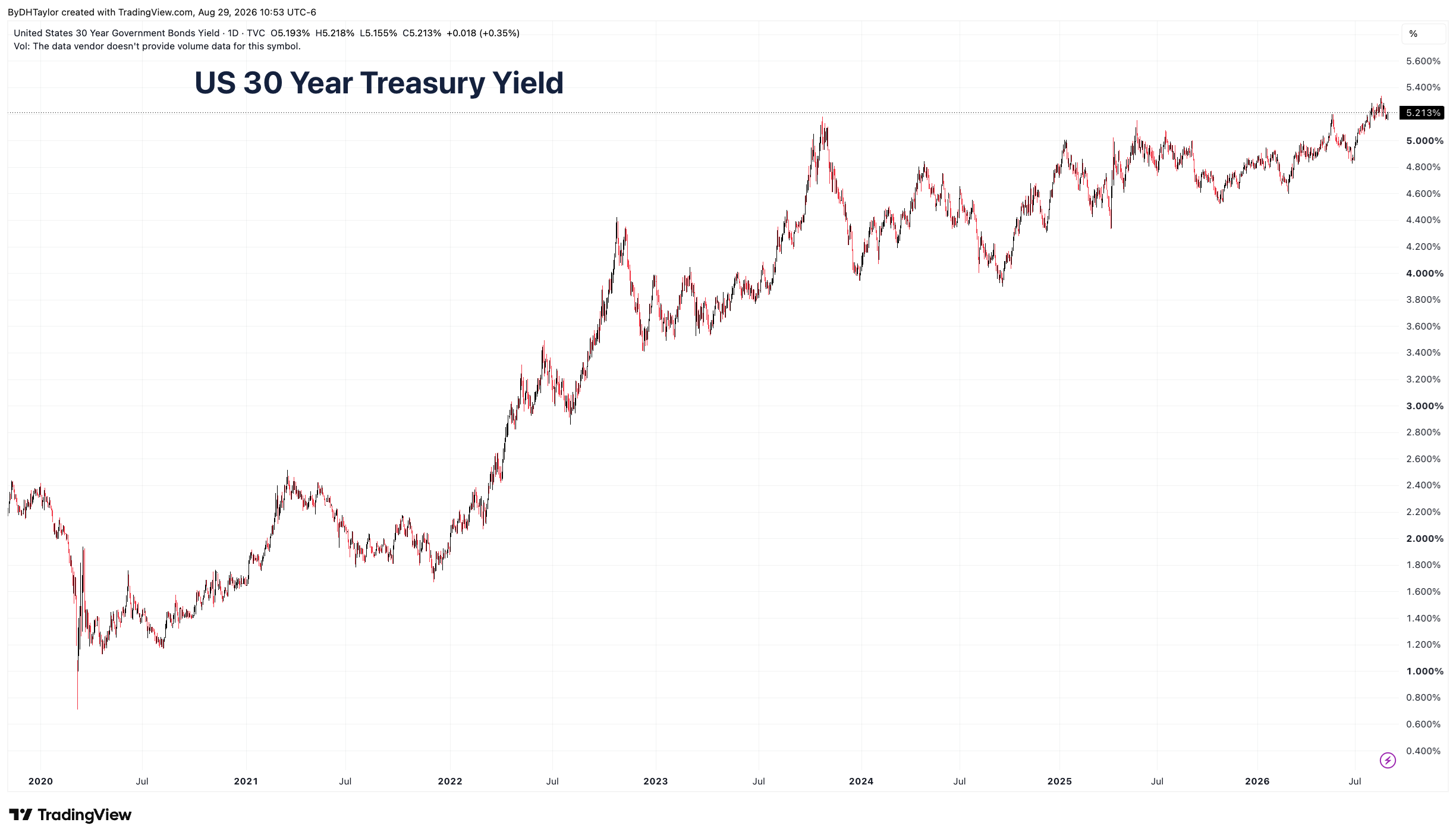
In the most recent view of interest rates, since 2020, long term debt yields have continuously risen. Interest rates are now near 7-year highs, and trending higher.
In order to coax investors to hold long-term debt instruments, there needs to be sufficient term-premium that brings in enough to cover the risk of holding the debt instrument to clear inflation levels as well as other risk factors.
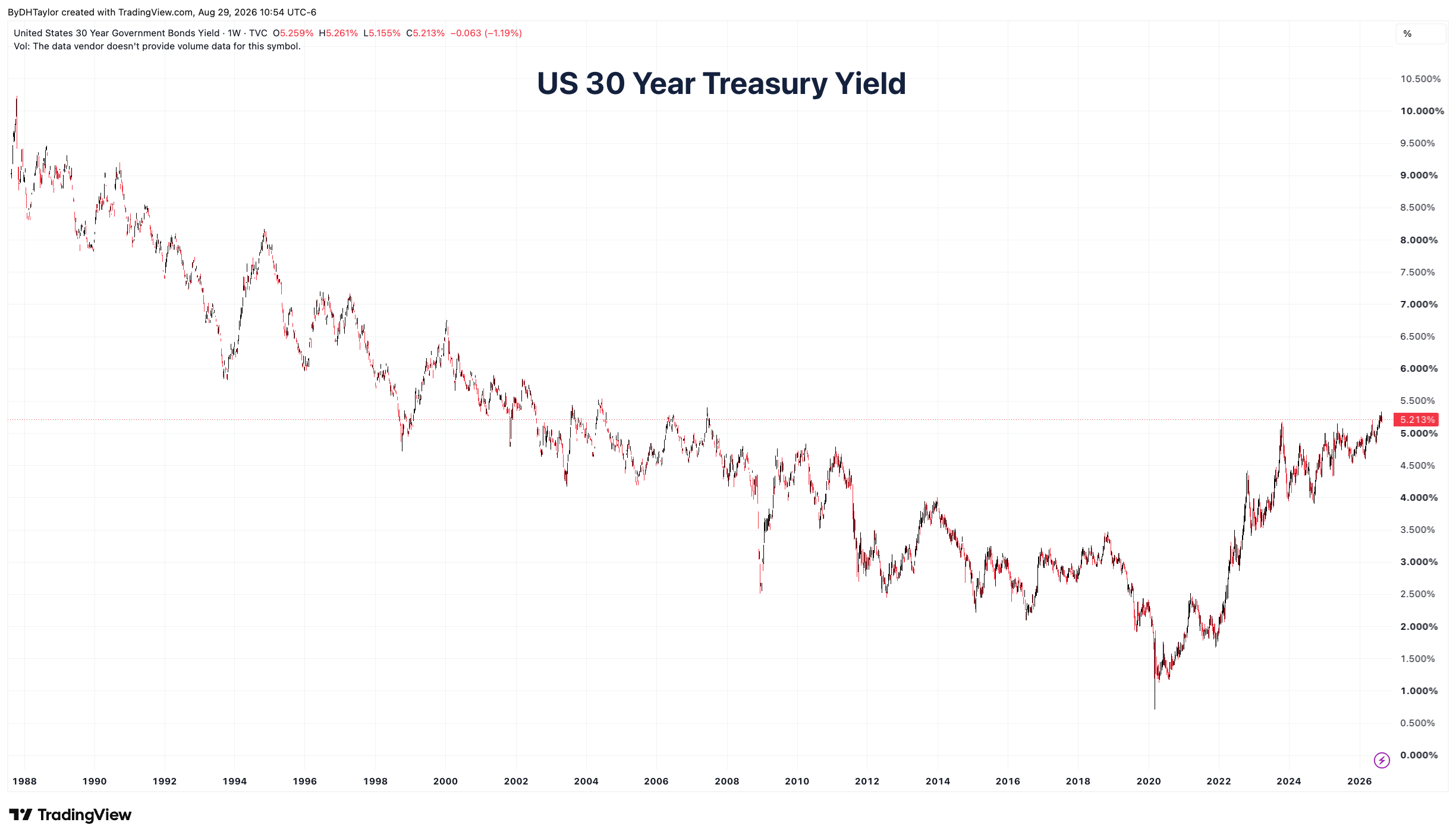
The current 30-year Treasury yield is standing at 5.30%. I believe that the 30 can move upwards even further to at least the 6.00% level within the following 18 months, through to the end of 2027. While I can see the bond yield moving additionally from the latest Jackson Hole summit news, I think this will be a slow, long-term trend upward instead of a spike. My belief is that with the continued deficit, with current inflation levels given tariffs and the war with Iran, as well as a massive level of debt from AI hyper-scalers, debt investors will have the upper hand in demanding higher term-premium.

TLT ETF
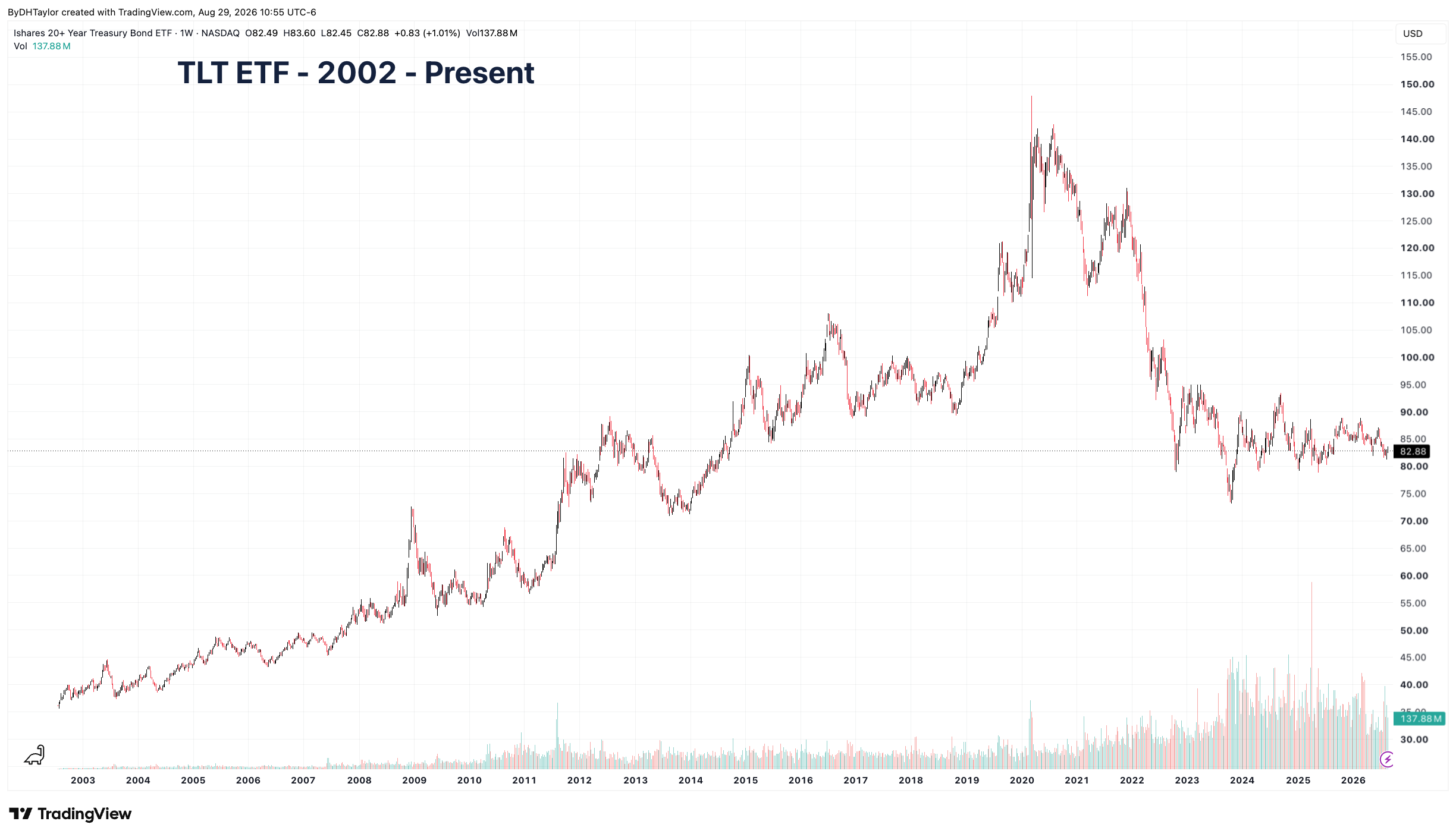
I do not believe the Fed will get hyper-aggressive, but instead, rely upon a lot of the moves that have already occurred with interest rates. If the short end continues to elevate, while the long end prices in higher risk premium, this could itself contain future upward price pressures. That, unfortunately, is the long, hard way of getting the job done of maintaining price stability.
I can see maybe to 25-basis point increases in the near future, then a long, very long, pause. In the meantime, the deficit will not shrink, and long end yields will continue to be elevated. Simultaneously, economic growth will soften as continued higher interest rates bear down on the economy. That, will affect the stock market, but at a very slow pace.
Then, there is Japan. The most recent intervention in the FX market to prop up the collapsing yen involved the Bank of Japan selling some $25B in US Treasury debt, long-dated, and then buying the yen in the open market. The Bank of Japan is holding ~$1.5T in US Treasury debt and they are the United States’ largest foreign debt holder. If the Bank of Japan continues doing this, that could also weigh on interest rates.
On the one hand, I do not see a way forward for lower interest rates. On the other hand, I do not see a complete collapse. I will continue to play the long, slow game of higher long-dated interest rates, and continue to sell into TLT ETF to take advantage of what is likely the new norm.
They will monetize the debt.