

Last week saw key economic indicators released, but also a slaughtering in the AI trade:
Money growth rates, Incomes & Expenditures remain positive
Key AI trade stocks sold off on overspend concerns as well as debt levels
So what?
While the economy remains firm, the AI trade has propped up; if the AI trade stumbles, stocks may continue their selling

M2 Money Supply
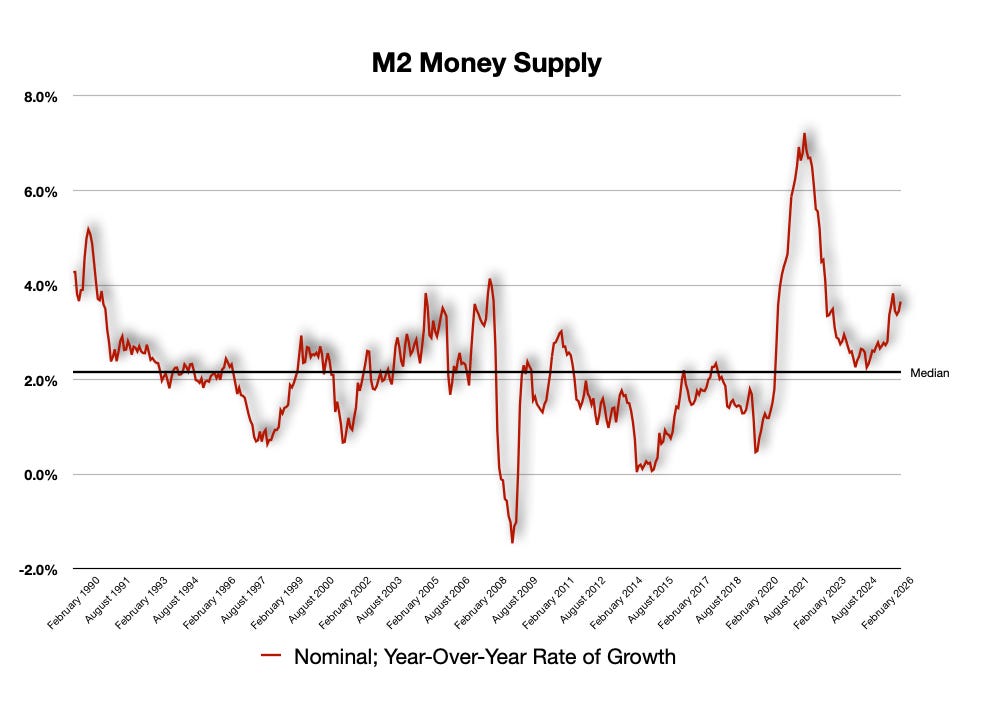
Nominally, money growth rates are increasing. For me, looking at this chart ‘begins’ the economy’s analysis.
The increase in the money supply rate is robust showing that new money creation is well above the median. Mostly, the dollar is being devalued from within as the printing presses are pushing to dilute the debt.
Looking backwards, excluding the 2008 financial crisis and COVID, the only other time that money being created at this rate of growth was back in the 1990s when core CPI inflation was running above the 5.00% level (See Core PCE below).
In that same time period, the Federal Funds rate was above the 8.00% level:
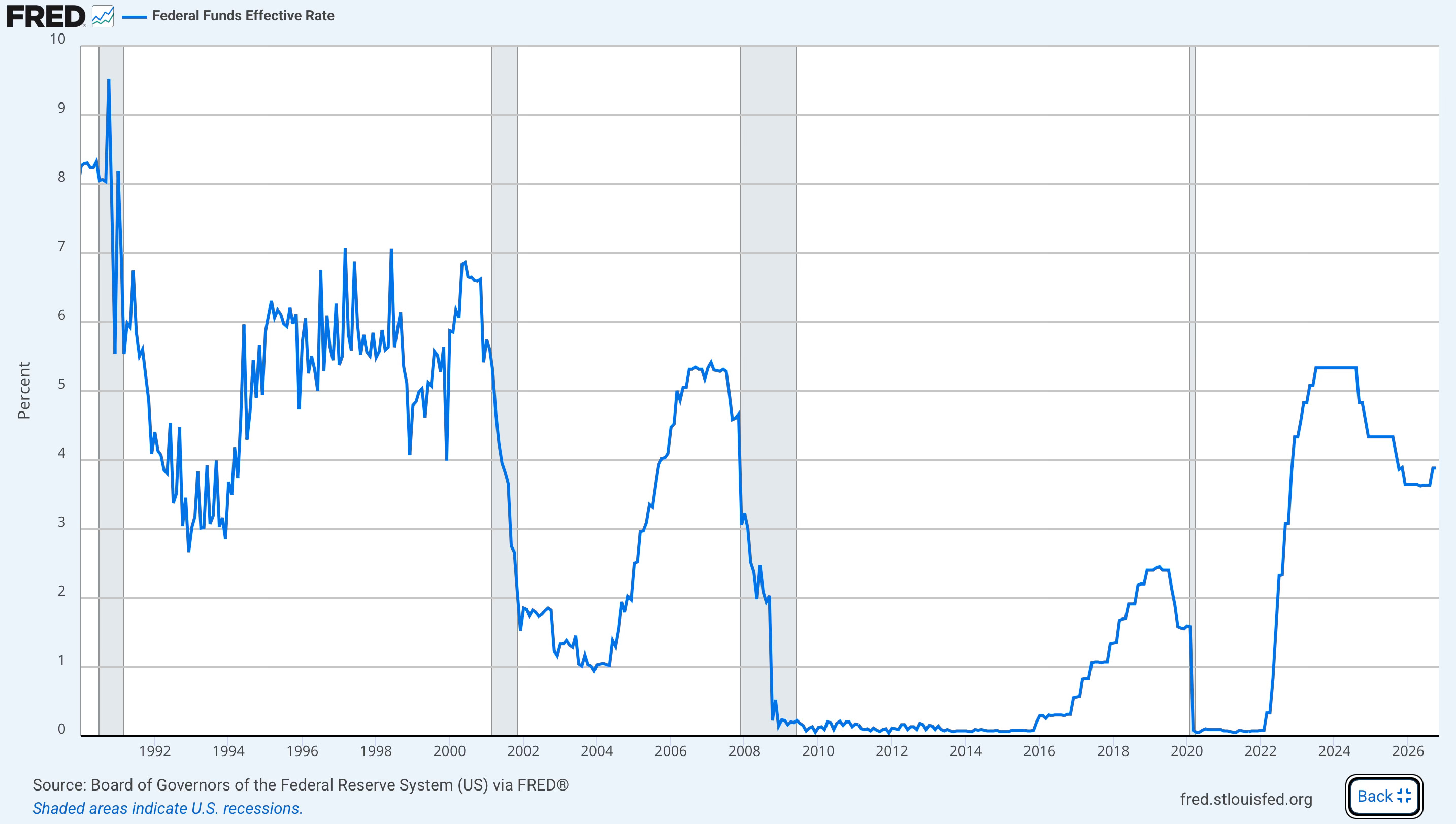
Inflation is a purely monetary thing, except when it is not. Nearly all of the current inflation is being driven by the tariffs and oil price increases. These two events are more price & supply shock than inflationary pressures from high demand.
Inflation is sticky and elevated. When the Federal Reserve created a massive amount of new money to alleviate the potential of a recession from the COVID shutdowns, taking on the massive expenditures from the Federal government, that money pumped into the economy. I had yelled at the top of my voice back in September 2024 that the Fed should not lower interest rates until its target rate of 2.00% was achieved.
After that, price increases increased and are firmly above the 3.00%, and climbing:
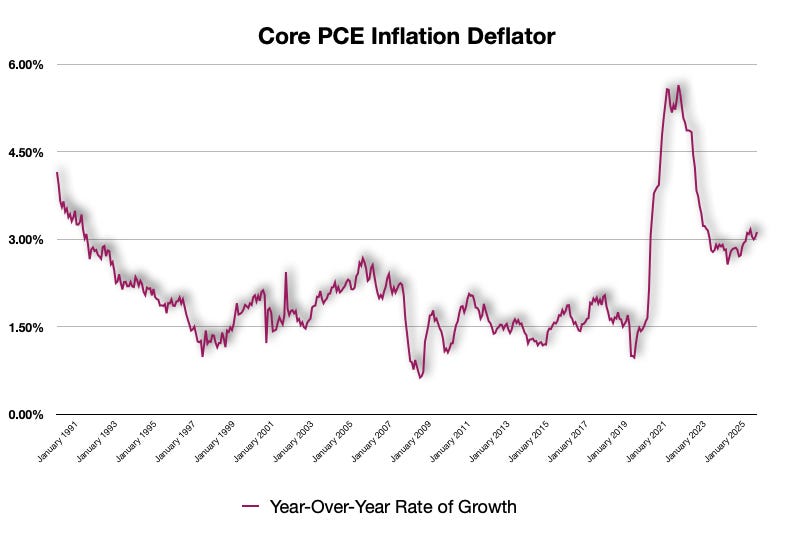
The Fed created an enormous amount of new money after the COVID shutdown, acquiring debt from the Federal government as well as other debt instruments from financial markets. This kept interest rates low, which spurred economic activity. The Fed almost held price increases down in this aftermath, but not quite–there may still be a lot of work ahead.
If the flow of oil were to return to normal, and if tariffs were to be removed, prices would fall. That would get the inflation rate back down to the 2.00% target rate, and just maybe the money supply growth rate would fall back to normal.
Personal Incomes & Personal Expenditures


While money is being created rapidly, the consumer remains in the fight—that should not be the way it is.
Income growth rates are low, grinding lower, and below median. If incomes continue to descend, eventually that will affect expenditures; there is a very strong correlation.
Looking at the personal expenditures side of the economy, consumers are keeping up regardless of the slow grind lower in incomes. This landscape can coexist for a period of time, but eventually the correlative effects of diminishing income growth will show up in expenditure growth.
A footnote to all of this is two-fold, in that the savings rate is declining while credit card debt is increasing—this is where the math morphs for a rising expenditure rate with a declining income rate.
Consumer Sentiment
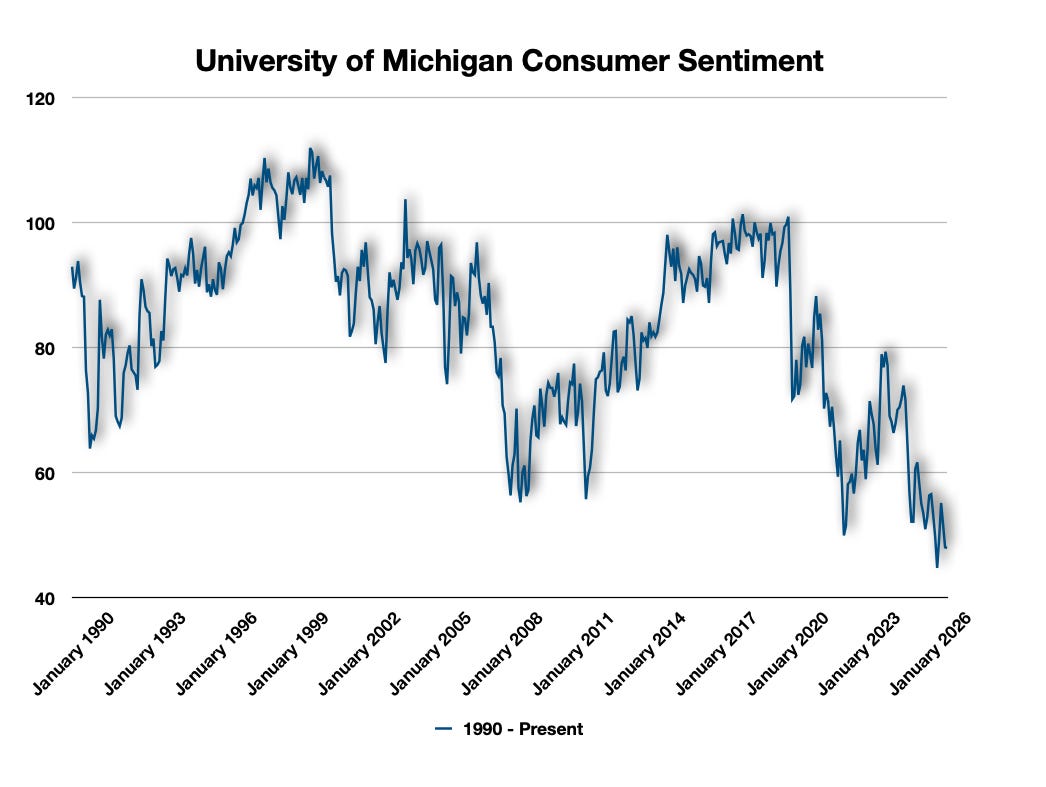
The consumer has kept in the fight for some time, but the data show that the consumer is at an all-time low in confidence. Keep in mind, the data goes back to the recession and inflation of the early 1990s, and subsequent recession, the Dot Com bubble collapse, the Great Recession from the 2008 financial crisis, and the COVID shutdowns.
If you look at the chart above, during COVID, the consumer cleared that 100 level, and then the level fell afterwards. While there as a recovery from June 2022 to March 2024, confidence is near historic lows.
It is important to correlate how important confidence is: Confidence Indexes show us the mood of the consumer, which gives us a good indication of what happens next with expenditures. If incomes do not pick up to an increasing level, eventually this chart will show up in expenditures. It is also important to keep in mind that future corporate revenues typically come from consumer expenditures.
From a purely classical economics foundation, when you look at money growth rates, personal incomes growth, expenditures, and then confidence, there is a tug of war between these data points—this is not a smooth, cohesive economy.

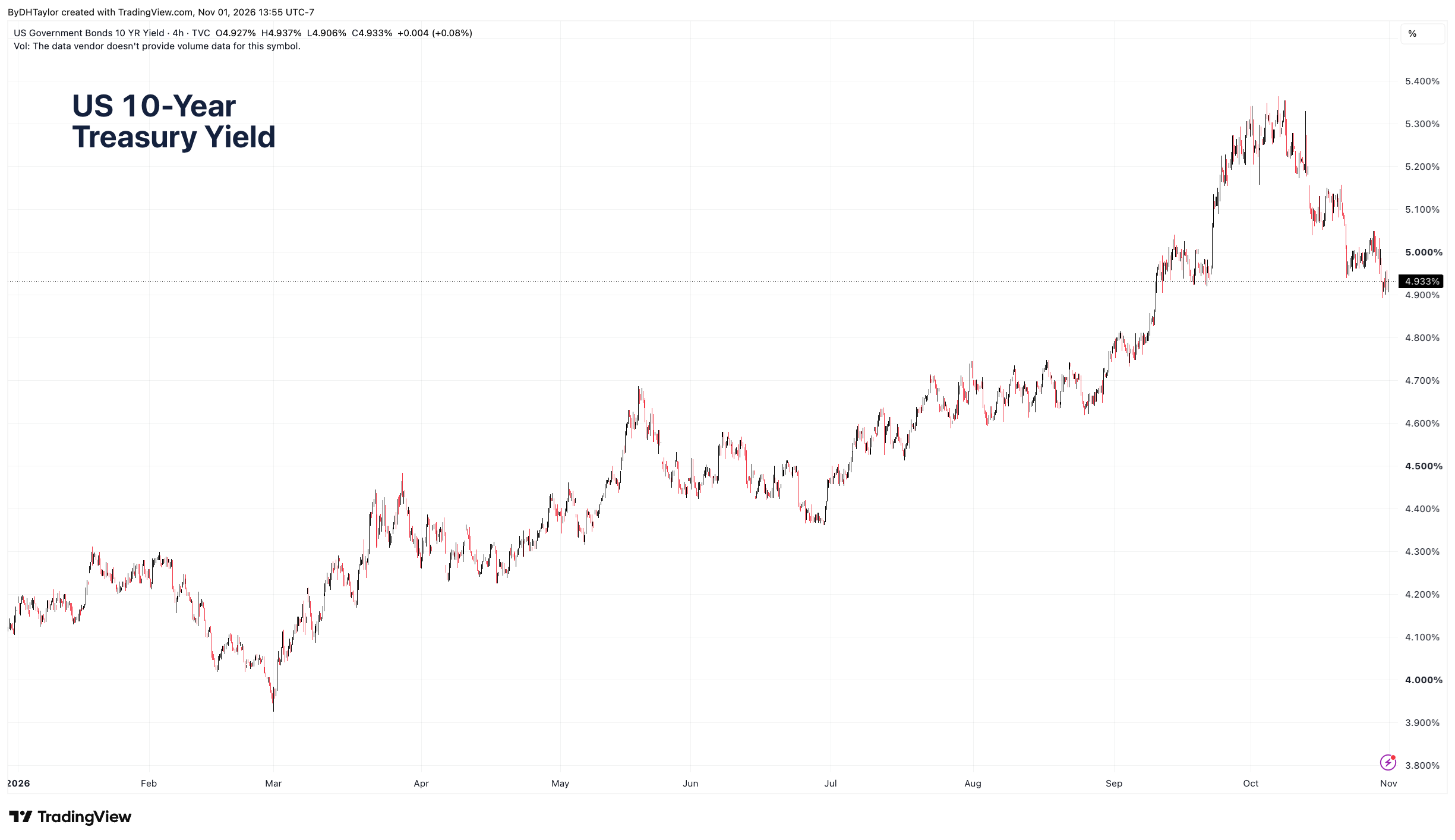
The rapid rise in the bond yield has abated, and just maybe the current high has been printed. Recent selling in the stock market may pull investors out of stocks and into more safe haven-esque investments.
There are a few factors that had contributed to the rise in the 10-year yield, one of which is the debt issuances by AI hyper-scalers. This is all being called into question, and the safety of Treasury debt may pull investors pulling yields downward.
As I had mentioned in a previous post, I sold off my TLT ETF trade, taking profits when long end yields spiked as high as they did. I’m not taking any new positions for now, but that will always be on the table.


This is where the real action came in last week: The AI trade took a significant hit. Does the selling have legs? I have always felt the AI trade was a bubble, but not necessarily a bubble from a traditional perspective. I believe this is a circular Jenga scheme that if one of most fragile blocks gets yanked, the entire tower comes crashing; every company’s respective future revenue and profit source depends upon every other company’s individual performance. I have never believed that the revenues were there, that while some companies, say Nvidia, are earning profits, others are far overextended without enough realistic potential to achieve its revenue goals. Debt levels are extraordinary, and the fact that every one of these data centers will need to be continuously re-upgraded with newer, more efficient processors means none of these companies will ever actually catch up.
These concerns are now being called into question by the broader market, and last week’s selling shows. The big question is: Will the selling continue?

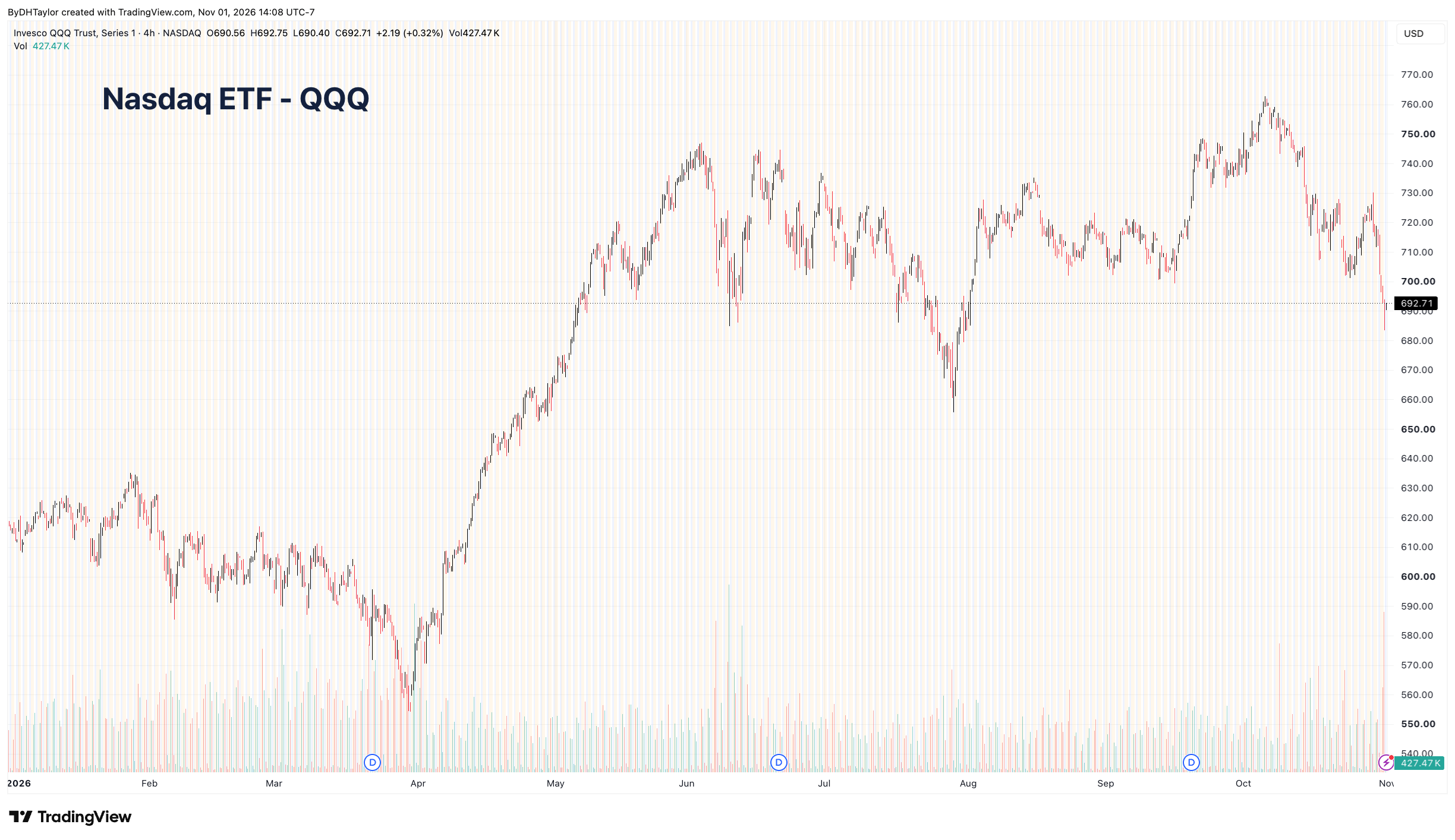
While last week’s selling was mostly sharp for some individual companies, the broader markets remain contained… for now.
Most companies have not performed nearly as exceptionally in the market this year as well as the AI hyper-scalers. most companies are at lows for the year, and if the market continues to sell like last week, there won’t be much to support the broader market.
This week is a very serious make-or-break position for the stock market. If individual investors call into question the reality of these stocks, then take profits, this could trigger selling more broadly.

On the one hand, every time the market feels like it wants to correct the AI trade, there is almost always a rally immediately thereafter. On the other hand, last week’s moves were quite different.
First, looking at the overall, broader economy, it remains firm for now. Inflation is sticky, but I do not see the Fed raising interest rates continually over the following few months and quarters—CME FedWatch tool has the 9DEC2026 level to move up to the 400 - 425 basis points:
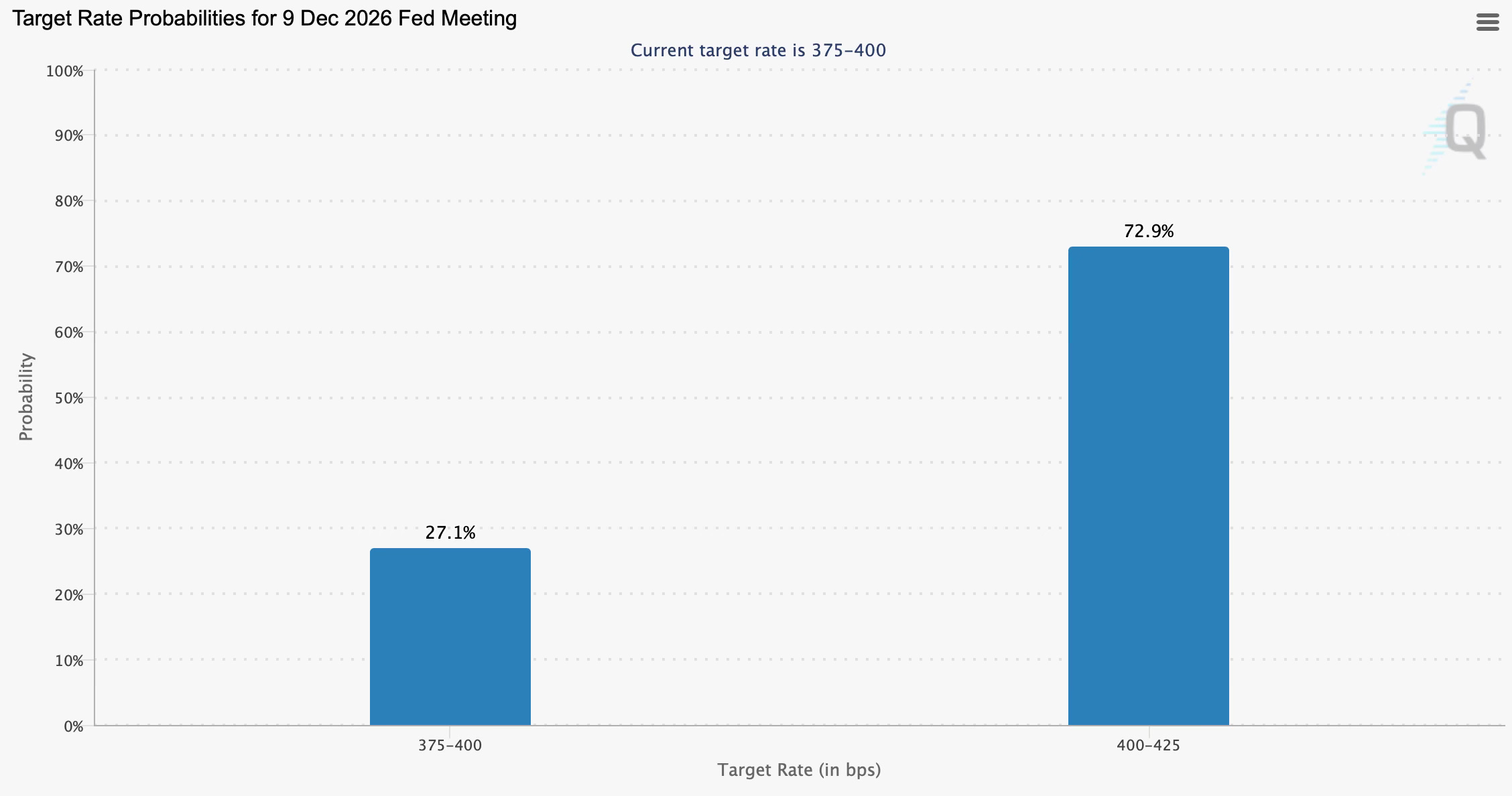
If short-term interest rates hit 500 basis in this tightening cycle, I would be surprised. Inflation is sticky, but other variables are likely to contain prices while also there will be an eventual end to the stoppage of oil flows through the Strait of Hormuz. A return to normalcy would mean oil prices will drop precipitously. The fact that oil prices are not sitting at $250.00 a barrel is telling that the market is anticipating a future end to that.
For me, I have many levels of options trades on and am expecting big moves in the markets. I believe the AI trade is what it is: A circular Jenga scheme. The foundation blocks are being called into question, and I really feel that the market is about to correct itself.
The current economic data may support the economy as it is, so perhaps there is some respite as well as a potential bottom if the market slides further.
