
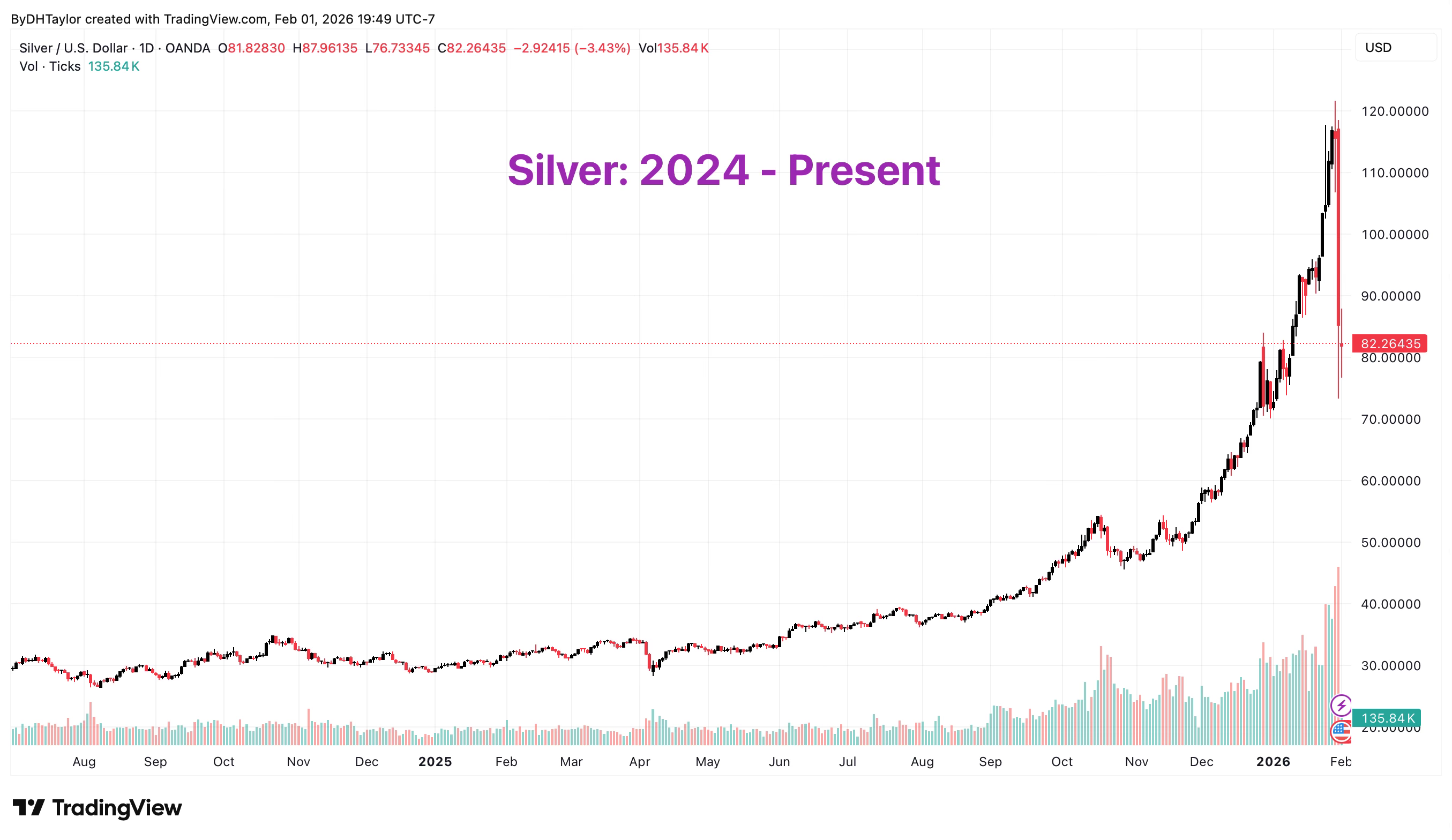
Silver saw an amazing run-up in price from about $30.00 mid last year to over $120.00 on Thursday night, only to see some 39% get clipped off in price. There are a few rumors as to what drove this to include a hawkish Federal Reserve pick—an odd choice considering Trump wants lower interest rates—to simple, old-fashioned profit taking. Regardless, the move was swift and spectacular, and it rippled throughout the entire market.
Where to now?
I had begun to consider a few things about silver in just the past few posts. I own some physical silver and have been sitting on these coins for a long period of time—when the price was about $20.00 - $25.00, I would buy a few here and there and have accumulated a nice collection. One thing I had been considering up until Thursday was when to sell. Now, if the price drops below $30.00 again, I will continue to accumulate far more, but with more specific intentions.
In the more short-term timeframe, silver’s collapse makes analysis a little more interesting. There were many things that occurred last week that need to be looked at as collectively, they may be the beginning of a far bigger move. I don’t see silver holding this price for too long, and I expect we may see a move lower toward $50.00.
US Dollar Index
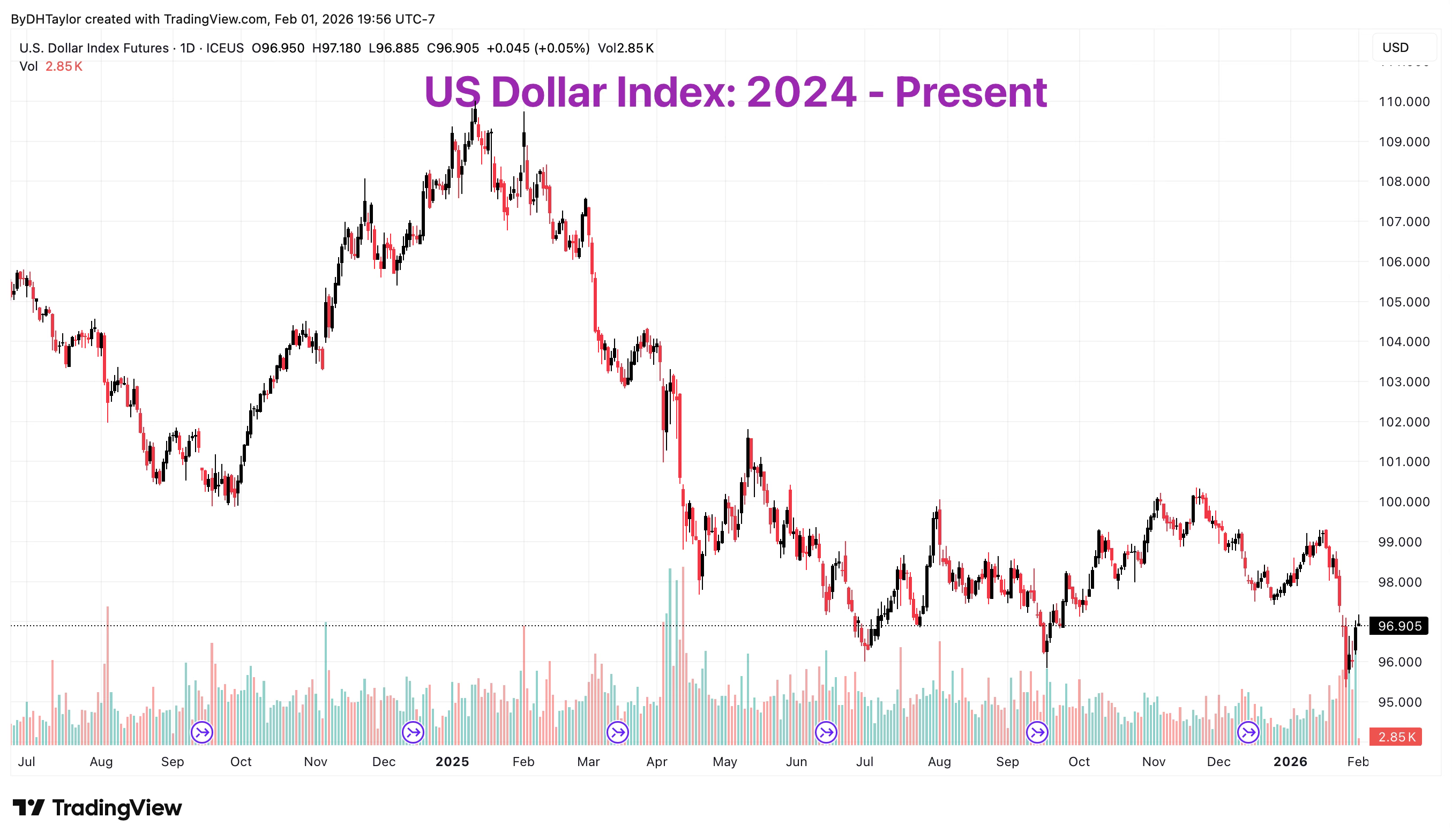
The dollar was selling off last week due to the Japanese yen carry trade starting to unwind, but the greenback proved to be the safe-haven that it always has been.
The Japanese yen had begun to soften too fast, and both the Bank of Japan (BoJ) and New York Federal Reserve Bank branch ‘checked’ rates, the last thing they typically do prior to coordinated intervention. With all of the Japanese debt the BoJ had acquired over the past nearly three decades, true price discovery is happening in the markets, and interest rates for Japanese Government Bonds (JGBs) soared.
The dollar sold off when the yen started to rally again. Then, however, the dollar found footing with all of the other selling in the markets.
In the meantime, “true price discovery” will trickle through to all other areas of the world economies, and I expect to see continued pressure on bond prices, keeping bond yields moving upward.
Interestingly, AI is also having an effect on bond prices, which may pressure bond yields higher: Nearly all of the AI infrastructure buildup is occurring with debt, and raising money along side government bond supply is simultaneously pressuring bond prices lower, which is pushing yields up somewhat.
Equity Markets
The AI Trade
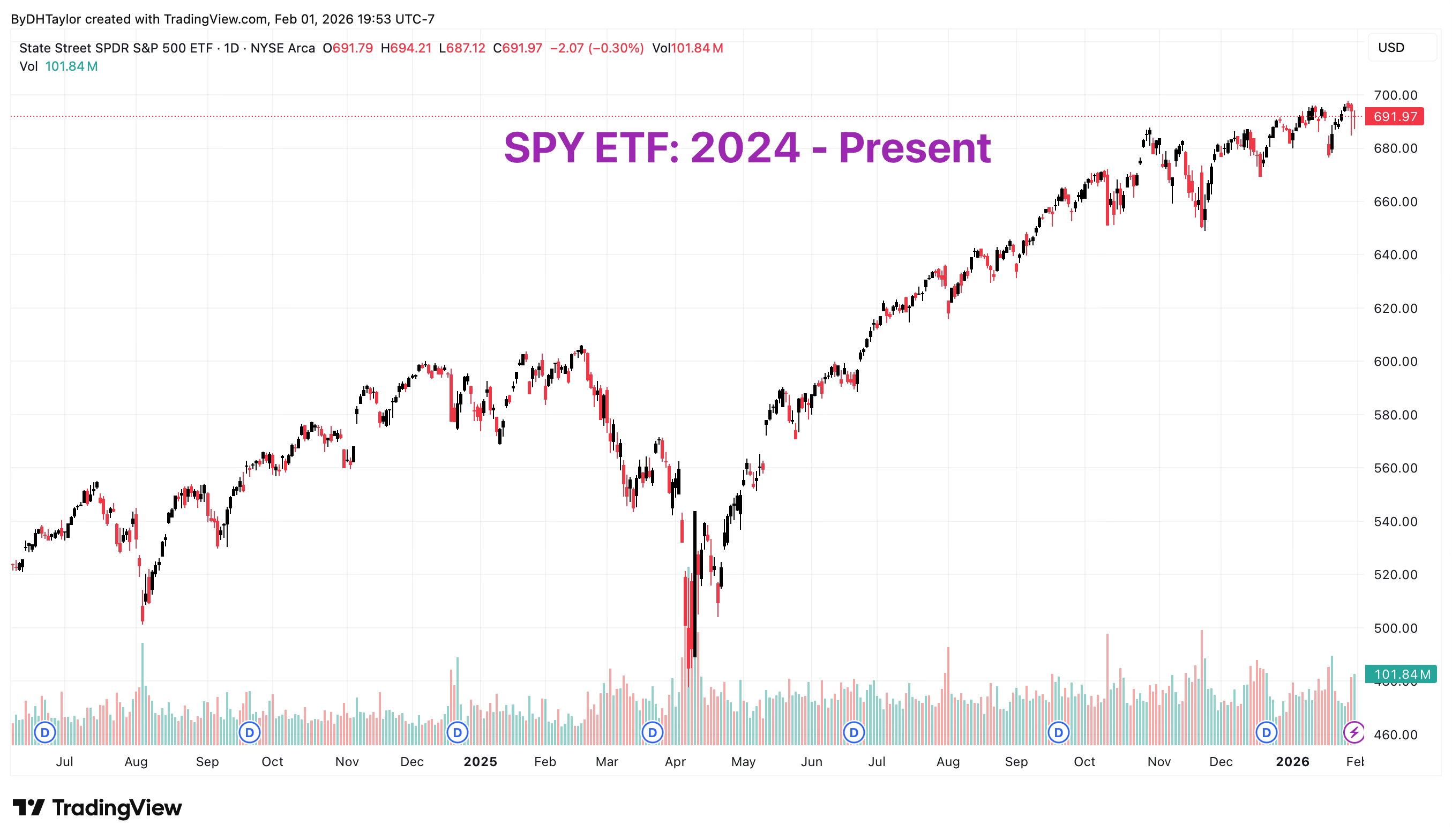
The real story behind the stock market moves over the past year has been AI, of course. The market has pushed to all-time highs regularly as the world gears up for Artificial Intelligence, and companies poise to gain as much as they can of the potential revenue.
The infrastructure spend on data centers is what has been driving the economic growth we’ve seen over the past year. Now, however, the market wants to see a payoff. Last week, two key players’ respective stocks went in different directions. The new story is advertisement versus enterprise—we are likely witnessing the breaking of the all-in AI Trade, but finding where the payoffs are going to pay off.
Meta Platforms
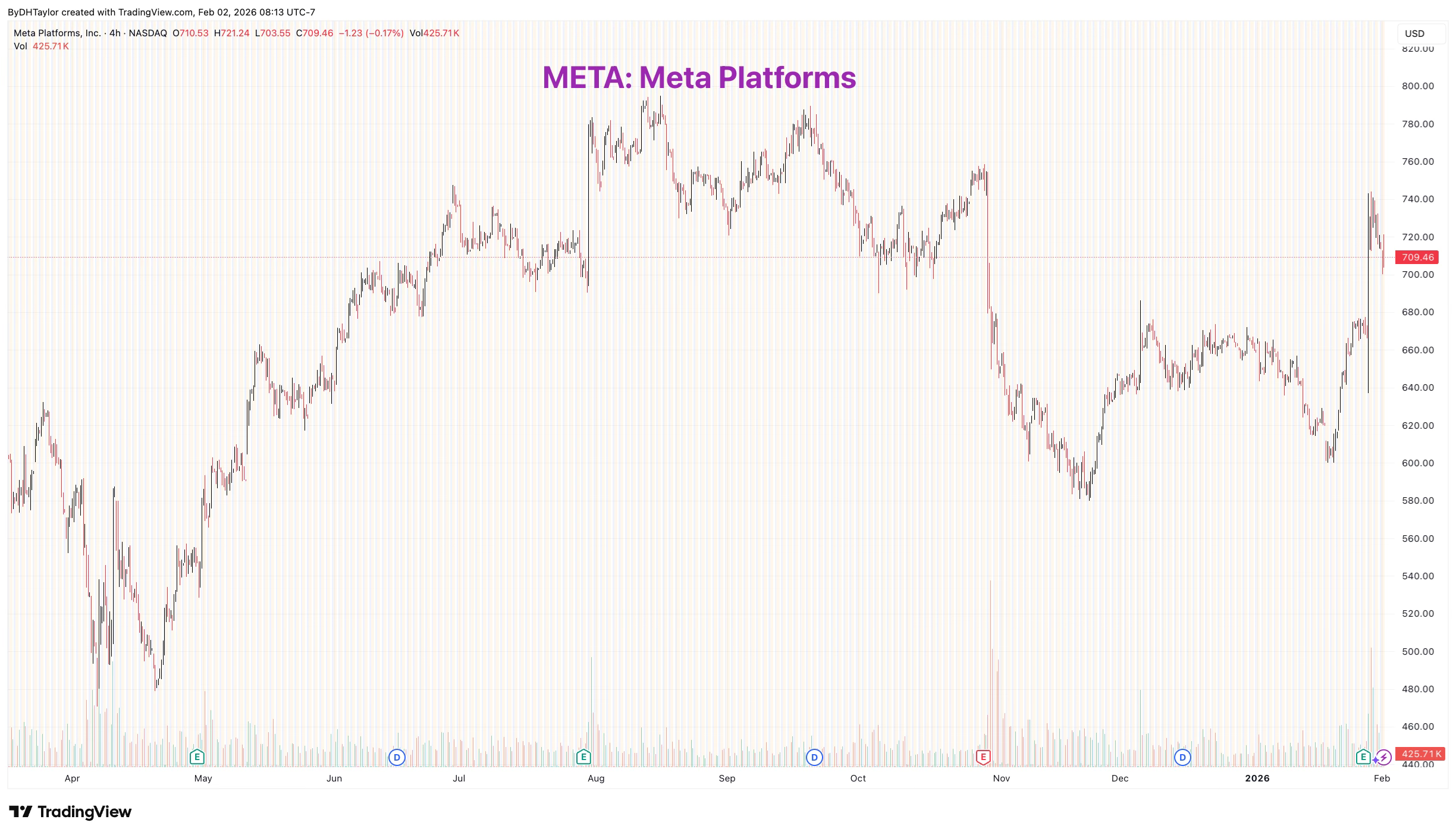
Meta Platforms is proving where profits are easily transitioned from investments. The past week, the social media giant is showing the benefits of connecting advertisements to AI, and the profits are there. Meta stock rallied after its earnings release beat across the board with an upbeat outlook.
With his line of thinking, think about others that would benefit similarly: Amazon & Alphabet.
In stark contrast, however, there is the enterprise portion of the AI Trade.
Microsoft
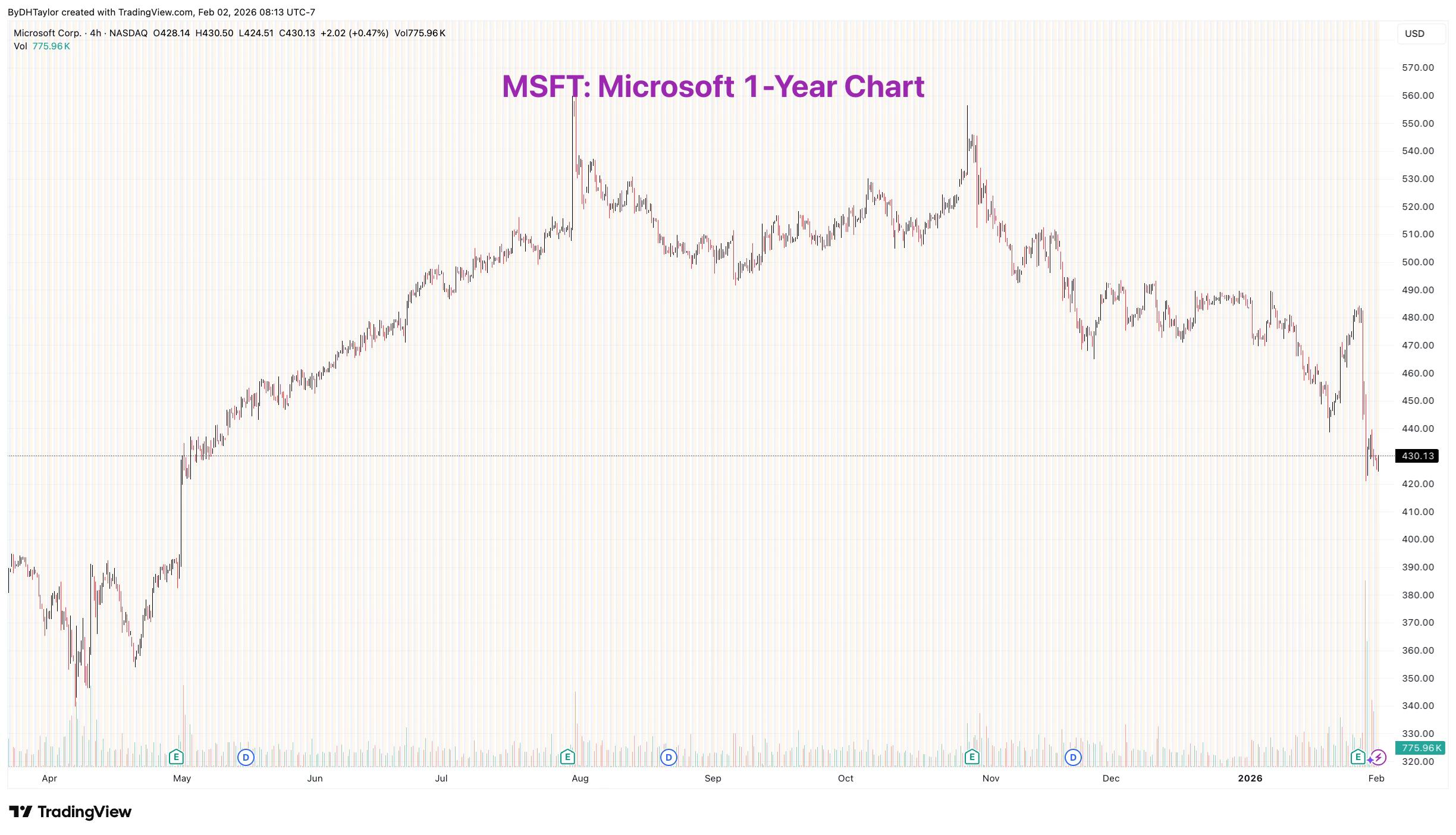
The bottom line with Microsoft is that they are spending big, putting more money on the table, but not seeing a growth rate in revenue and profits commensurate with their investments. As you can see in the chart, MSFT stock took a massive fall of some 12% after earnings showed even more money being spent, but the rate of growth in profits slowing—the market was not happy. Transitioning enterprise into paying customers has not been a fast process. This was also reiterated with SAP and others showing growth rates for
This is adding up to ‘AI ROI’ concerns, and this may be the moment where we no longer see an all-in AI Trade, but diverging segments of the AI Trade.
The enterprise segment of the AI trade is significant. If this portion fails to meet expectations, the entire AI trade may buckle under the weight of future expectations.
US Treasuries
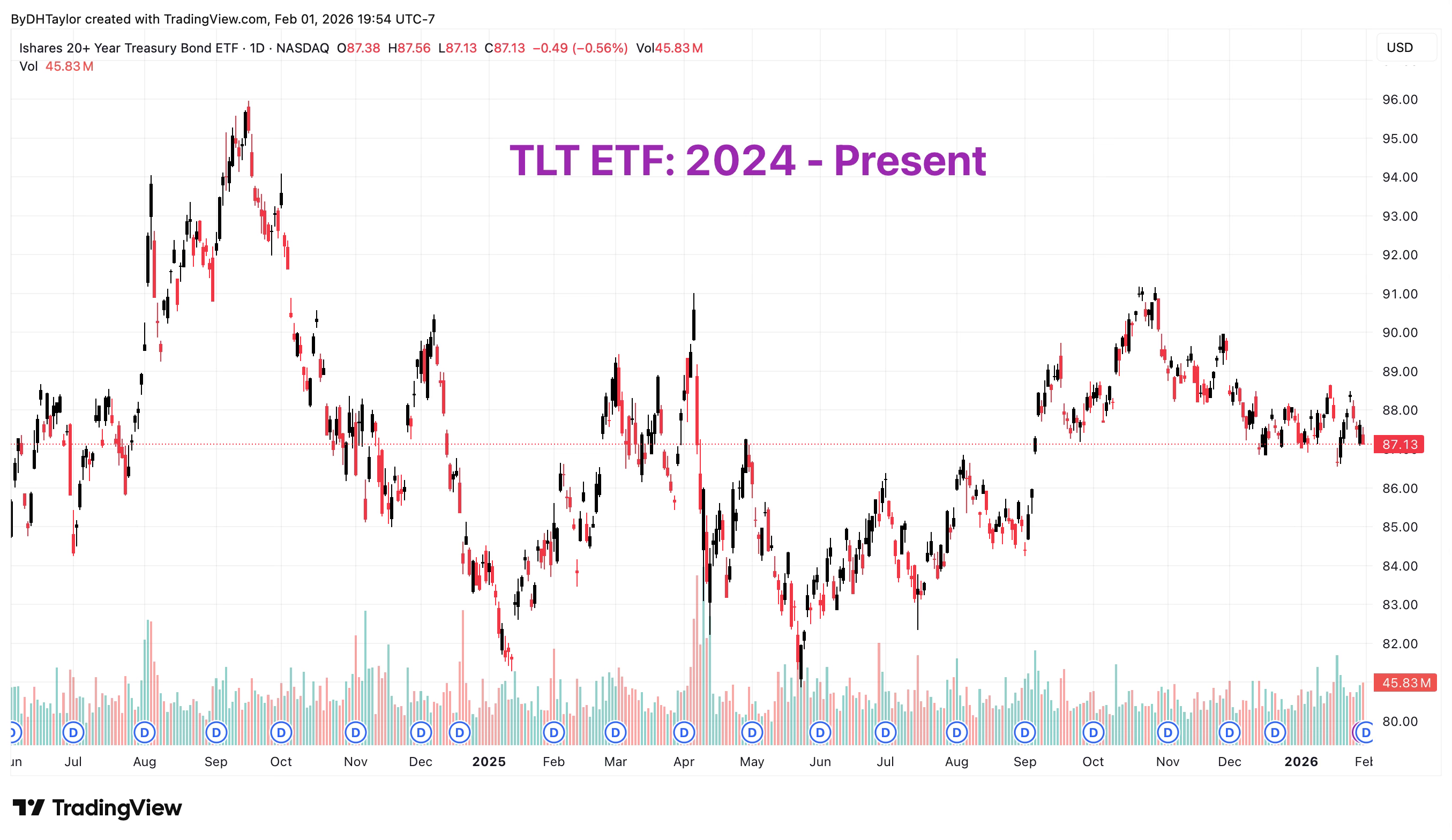
As I mentioned, many factors are affecting the price of bonds, and how TLT ETF has been affected. The debasement of money supplies around the globe will have an effect on price discovery. Now that Japan is going to have to pay a legitimate price for its debt, artificially low bond yields will go away worldwide. Factor in the AI debt load, that adds more downward pressure to bond prices, and be correlated extension, upward yields. If the dollar continues to falter, that would be a sign of diminishing demand for the greenback, and if the AI trade starts to wobble further, the stock market and US dollar are likely to seen continued selling—and considering what is propping up the economy, if those legs of the table get removed, it could get ugly.
I remain long my TBT trade, and I will continue to sell TLT vertical call spreads, near-dated, out-of-the money to bring in premium. In this environment, and factoring in that a nominee for the Fed has proven to be hawkish, I do not see an environment where bond prices move down, and TLT moves up.
AI Prediction
I am in a short position on SPY ETF, and have been making profits from it. I have been using AI via abacus.ai for research. Mostly, my thinking has been that this move in the stock market may be over with on a short-term perspective.
I have a short SPY ETF vertical call spread, 701 / 702 selling for $0.43, with about 19 DTE, and a long vertical put spread, 681 / 682 paying $0.28 with the same expiry. I have sold a few additional vertical call spreads and put spreads versus this position within the bigger move. I am profitable on this trade for this month, but I get the impression that AI wants me to take my profits soon as it has declared more than once I have “won the trade”, but I am going to persist just a bit longer—I want to see this out through this week s I think we may get a series move to the downside with all of the market moves we’ve seen over the past few days.
For right now, after selling two rounds of options versus this position, and the overall position itself, I am up about $0.40 overall with what is mostly minimal risk.
The Query
The market saw significant moves last week, and going into this week, I wanted to coordinate everything I am considering as a potential for the market outlook.
First, the big news was the massive selloff in silver—39% top-to-bottom in one day, which brought many segments of the market down. The metals market was being pushed by the so-called debasement trade, but that has been checked. The new Federal Reserve Chairman nominee can be hawkish, and debasing currencies requires ultra-low interest rates.
Next, the AI Trade suffered some wobbling over the past week as Microsoft showed conversion of enterprise customers difficult, whereas Meta is showing that direct-to-consumer marketing is profitable with its AI ads on their platforms. I see this a the beginning of a divergence in the AI trade in that despite companies continually investing heavily, the market will shift to rewarding those enterprises that are seeing growing revenue & profits.
With this, the stock market had hit a new all-time high on Wednesday night, only to sell off on fatigue and other factors going into Friday. While this is happening, the US dollar was sold off because of the Bank of Japan checking rates to stem the selloff in the yen.
At the same time, US Treasury yields still remain pressured upward and likely to continue with the AI debt loads, the true price discovery of Japanese bonds, and the debasement of the US dollar and US debt.
I still hold the 701 / 702 short vertical call spread and long 681 / 682 vertical put spread where they are sitting at near even. However, I have sold short-dated vertical spreads versus this position to bring a total of about $0.40.
I need you to become more hyper-critical in your projections for the potential market moves, as well as more adversarial in your response to my thinking on market moves. Given that, what happens this week with the markets?
The Response
You want adversarial, so I’m going to challenge the weak links in your chain first, then give you a tight base-case + fat-tail map for this week, and finally translate it into what matters for your 701/702 short call spread + 681/682 long put spread and your “I’ve harvested ~$0.40 already” overlay.
1) Your “silver crash = debasement trade checked” story is plausible — but you’re overconfident on causality
Yes, the silver move was violent and mechanical. Reports put silver down ~30%+ in a day (and as much as ~36% intraday), worst in decades, with forced selling/margin dynamics and a “hawkish Fed chair nominee” narrative (CNBC, MINING.COM). That absolutely can coincide with “debasement” getting crowded and then flushed.
Adversarial point: a debasement trade can be “checked” on price and still remain “true” on fundamentals. A parabolic unwind tells you more about:
leverage/margins/positioning,
narrative crowding,
and liquidity holes
…than about the long-term direction of “currency debasement.”
So if you’re using the silver crash as a clean macro regime shift (“now we’re hawkish, debasement is done”), that’s too neat. The real conclusion is: the market just proved it will punish crowded one-way hedges. That has second-order implications for equities (see below).
2) “Hawkish nominee implies less debasement” — true, but the market can whipsaw this hard
The same CNBC write-up even flags “don’t overdo the hawkish trade / risk of whipsaw” around the nominee narrative (CNBC). Translation: the first move is positioning + reflex; the second move is the market asking “OK, but what policy actually happens?”
Your risk this week is not “hawkish wins.” Your risk is cross-asset reflexivity:
USD spikes → metals puke → risk-parity / vol-control delever → equities dip
then dip-buyers show up because growth isn’t collapsing → equities rebound
meanwhile long-end yields can stay sticky if term premium is the real driver
That’s a nasty environment for clean narratives.
3) Your AI divergence read is strong — but you’re ignoring the more dangerous version of it
You’re saying: “Market will reward AI that converts into revenue/profit; MSFT showed conversion is hard; META shows monetization works.”
Adversarial point: the more dangerous variant is:
The market starts to price AI capex as a balance-sheet/financing problem (duration + credit + free-cash-flow), not a TAM story.
If that shift happens, it doesn’t just create “winners/losers.” It can compress the index multiple because Mag-7 are index gravity and because the “AI = long duration equity” complex is sensitive to real rates/term premium.
So: your AI divergence thesis may be right, but the index-level implication can still be bearish or choppy rather than “rotation saves the tape.”
4) “USD sold because BoJ checked rates” — this is internally inconsistent as stated
If BoJ is “checking rates” to stem yen weakness, the immediate impulse is often JPY stronger / USDJPY down, which can mechanically look like “USD weaker.” Fine.
Adversarial point: what matters for SPY isn’t DXY vibes; it’s whether FX is:
orderly (helpful),
or disorderly (correlation goes to 1, liquidity gets pulled).
If the market thinks Japan is losing control of the long end and has to choose between JGB volatility and FX stability, that’s not a simple “USD down = risk on” story. It’s a global VAR shock story.
5) “Treasury yields pressured up due to AI debt loads / Japan bonds / debasement” — you’re mixing drivers that don’t all point the same way
AI CapEx financed with debt can push issuance/term premium up (TLT down).
Japan renormalization can reduce foreign bid or raise hedge costs up (TLT down).
“Debasement” can mean inflation risk up (TLT down) — but your own premise says debasement trade just got checked.
So the consistent takeaway is:
Rates can stay high even if risk assets wobble.
That’s the regime that breaks the “TLT saves you” reflex and makes SPY corrections feel worse (multiple compression).
What happens this week? (Hyper-critical base case + tails)
Base case (most likely): chop with violent intraday swings
After a forced unwind (metals) and wobble in AI leadership, markets often do:
mean reversion in price,
but volatility stays elevated because positioning is damaged and liquidity providers widen.
So you should plan for:
SPY range trade with headline-driven air pockets
Rates sticky (TLT heavy), unless there’s a true growth scare
Leadership narrowing (stock-pickers’ tape inside the index)
Downside tail (your trade’s payoff): “risk-off without duration hedge”
This is the one you actually want for your structure:
equities down
yields not down much (or even up)
credit spreads widen a bit
“AI capex as burden” narrative spreads
This produces a grind/flush toward your 681 area.
Upside tail (the one that hurts you): re-leveraging / “buy the dip” with falling vol
After a positioning washout, if earnings aren’t disastrous and liquidity returns, the market can:
rally on “it’s fine”
vol collapses
grind upward (most painful path for bearish option structures)
This is how you get tagged toward 701/702.
__________________________________________________
Now, your actual structure: why your current setup is not as attractive as it feels
You hold:
Short 701/702 call spread (max loss = 1.00 minus credit on that spread)
Long 681/682 put spread (max gain = 1.00 minus debit on that spread)
Net: synthetic short with defined rails, currently near even
You also harvested about $0.40 via short-dated spreads (nice work)
Here’s the adversarial truth:
At current spot (you said near even; earlier you cited ~693), your strikes mean:
You only get full win if SPY is ≤ 681 at expiry (or close enough that the put spread is mostly/fully in the money).
You take full pain if SPY is ≥ 702 at expiry.
The most likely weekly outcome (chop around 690s) is the slow-burn worst case: neither wing pays meaningfully, and time passes.
The $0.40 you harvested helps a lot, but don’t let it trick you into thinking you’re “safe.” It mainly:
reduces your breakeven pain,
but does not remove the upside tail risk if SPY trends to 702.
What your structure is really betting, whether you say it or not
It’s betting that either:
We get another downside impulse (risk-off / AI de-rate / rates sticky), or
Vol stays high enough that you can keep harvesting short-dated spreads to subsidize carry.
If we instead get:
SPY melt-up + vol crush,
you’ll find it harder to “sell noise” because there is less noise to sell, and your short call spread becomes the dominant risk.
What I’d plan for this week (in actionable checkpoints, not advice)
If SPY trades 698–701 at any point
Treat it as a “yellow alert.”
Your short call spread is about to dominate your P&L.
You need a plan for whether you will reduce/roll/hedge before 702 is threatened.
If SPY trades 686–688
That’s your market telling you the downside thesis is alive.
You don’t need heroics; you need follow-through.
Watch whether TLT is down or flat on that move (bad-mix regime). If yes, downside can persist.
If SPY sits 690–695 all week
That’s the “death by time” regime.
Your best edge becomes what you already did well: harvest short-dated premium when headlines spike.
But the market will try to lure you into oversizing that overlay. Don’t.
__________________________________________________
My adversarial forecast, stated plainly
Most likely this week: SPY churns, with sharp intraday swings, and you don’t get paid enough for being short unless a catalyst hits.
Second most likely: a downside impulse toward the high 680s (good for you, but not yet max payout).
Upside risk: a squeeze toward 700+ on “earnings fine / metals unwind is contained / dip-buying returns,” which is the path that can make your position uncomfortable fast.
My Take
I wanted to impart a bit of harshness into the analysis to add some ‘critical thinking’, which maybe that will impart a bit of my own critical thinking. On the one hand, the stock market hit yet another all-time high last week, but managed to move downward on the very concerns I have been outlining. I have logged some profits versus this bigger trade, and I believe that this has worked out. Having to look at so many moving parts at once is not easy, and someone sitting on my shoulder has helped—the profits have helped as well. I will continue to hold this position and I am looking for more opportunities to sell options versus this position in order to bring in more profits. We may see additional all-time highs, but I think there is some weakness in the markets, and it is possible that there is a bigger selloff at some point.